Student Lecture Transcription Guide
A student lecture transcription guide for faster notes, cleaner study materials, and less stress before exams, papers, and group projects.
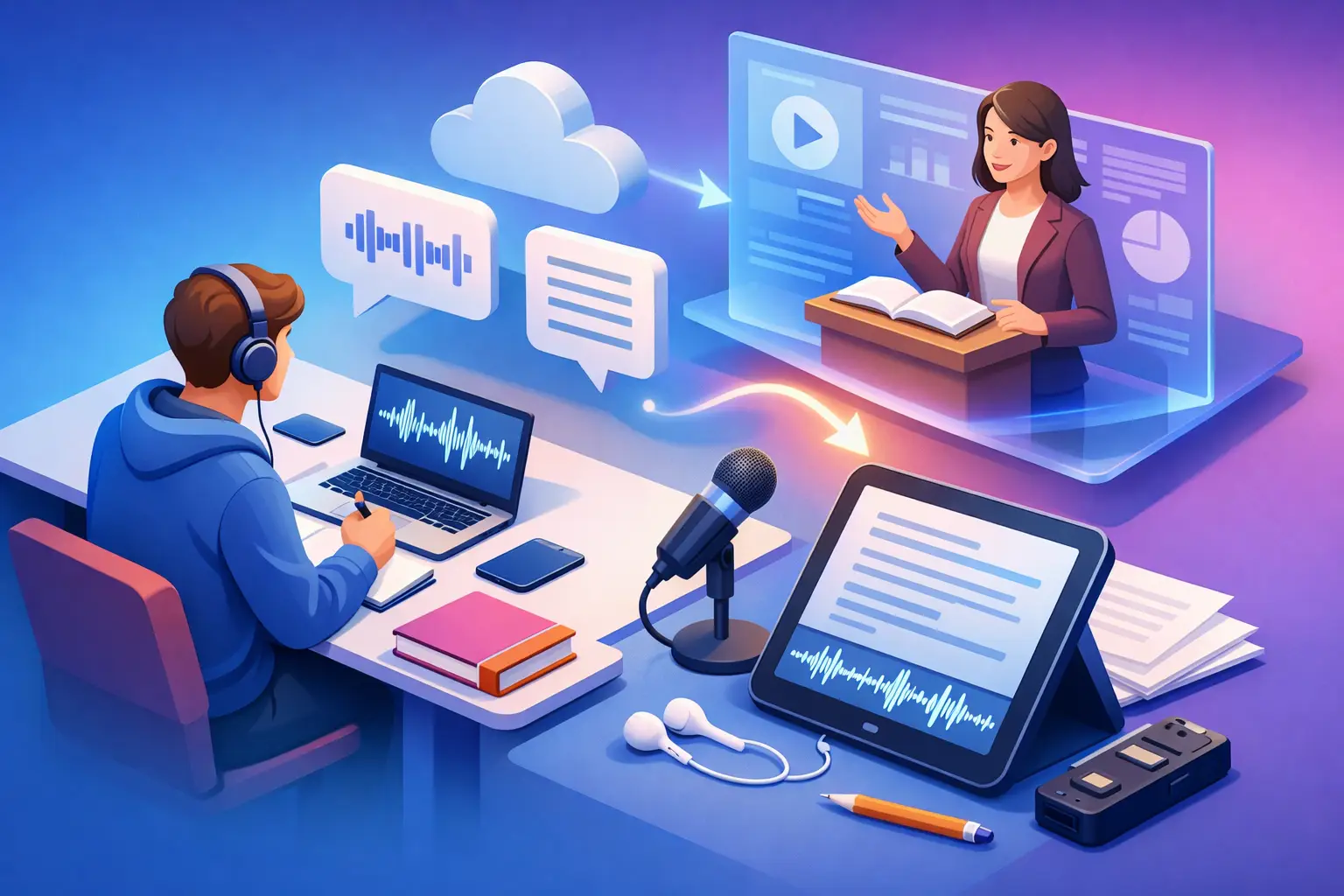
You miss one definition, look down to catch up, and the professor is already three slides ahead. That is exactly where a student lecture transcription guide helps. Instead of trying to write every word in real time, you can turn lectures into editable text, review the parts that matter, and spend your energy on learning rather than scrambling.
The goal is not to replace thinking with a transcript. It is to give yourself a cleaner starting point. A good transcript helps you find key terms fast, pull quotes for papers, build study guides, and review difficult sections without replaying an hour-long recording three times.
What a student lecture transcription guide should actually help you do
Most students do not need a complicated workflow. They need a repeatable one. Record the lecture clearly, convert it to text, clean up the rough spots, and turn that text into notes you will actually use.
That sounds simple because it is. The problem is usually not transcription itself. It is what happens before and after. Bad audio creates messy text. Raw transcripts become giant walls of words. Files end up buried in random folders. A useful system fixes all three.
A transcript is best when you treat it as source material, not the finished product. The raw text captures what was said. Your job is to shape it into something easier to scan before a quiz, easier to quote in an essay, and easier to share with a classmate.
Before class, set yourself up for a usable transcript
The quality of your transcript starts before the lecture begins. If your phone is at the bottom of a backpack, rubbing against a notebook zipper, the text output will show it. If you place it closer to the speaker and reduce background noise, accuracy usually improves right away.
Sit where the professor's voice is clear. Front or middle rows usually work better than the back. Keep the microphone unobstructed. If you are recording from a laptop or phone, make sure notifications are silenced so your audio is not interrupted by message alerts and random pings.
It also helps to label your files before you forget what they are. A name like "BIO 202 Week 4 Cell Respiration" is much more useful than "Recording 38." Small habits save real time later, especially during finals week when everything starts to blur together.
One more point matters here. Always follow your school's rules and your professor's policies around recording. Some instructors allow it freely. Others want advance permission. It depends on the class and the institution, so check first.
How to capture lectures without wrecking your workflow
There are two practical routes. You can transcribe a recorded lecture file after class, or you can use live speech capture during class. Both work. The better option depends on how you study.
If you like reviewing material later, recording first and transcribing after class gives you more control. You keep the original audio, which is helpful when a technical term comes out wrong in the transcript. This is also the safer choice for dense subjects like chemistry, law, or anatomy, where a single word can change the meaning.
If you want text immediately, live transcription can be useful. You see the lecture turn into words in real time and can mark sections to revisit later. The trade-off is that live capture may need a cleaner environment to stay accurate, especially in large lecture halls with side conversations, coughing, or echo.
For many students, the simplest setup is the best one: record the lecture, transcribe it soon after class, and do a quick cleanup while the material is still fresh.
Turning raw text into notes you can study from
A transcript is not automatically a study guide. Raw text often includes repeated phrases, filler words, side comments, and messy formatting. If you leave it untouched, it becomes long but not useful.
Start by breaking the transcript into sections that match the lecture structure. Use topic headings based on slides, chapters, or themes the professor emphasized. Then pull out the pieces that matter most: definitions, examples, formulas, dates, arguments, and anything the professor repeats.
This is also the point where you should trim. If a transcript gives you six lines of setup before the actual concept appears, cut it down. Keep the meaning. Drop the clutter. Shorter notes are easier to review and much easier to memorize.
A clean format helps more than students expect. Put major concepts on separate lines. Group related ideas together. If the lecture covered causes, effects, and case studies, organize the transcript that way instead of preserving the exact spoken order. Spoken language is rarely the best format for written review.
Student lecture transcription guide for better exam prep
When exams are coming, speed matters. Searchable transcripts give you an advantage because they let you find exact terms fast. If your professor says "this will be on the test" and mentions a specific model or theory, you can locate that part later without scanning pages of handwritten notes.
Transcripts are also useful when a course moves fast and concepts build on each other. In subjects like economics or biology, one weak lecture can throw off the next three. Having a written record lets you go back, fix the gap, and move forward without guessing.
That said, more text is not always better. If you keep every lecture as one giant document, review gets harder, not easier. Break transcripts into smaller study assets. Turn each lecture into a one-page summary, a question bank, or a short outline of likely exam topics. The transcript gives you depth. Your condensed notes give you speed.
Group projects are another strong use case. A transcript helps your team check what the professor actually assigned, what deadlines were mentioned, and how the project was framed. It cuts down on the usual "I thought they said Friday" confusion.
Common transcription mistakes students make
The first mistake is trusting raw output too much. Transcription is fast, but it is not magic. Specialized vocabulary, accents, room noise, and overlapping speech can create errors. If a sentence seems off, check it against the audio before you build your notes around it.
The second mistake is recording everything and reviewing nothing. A transcript only helps if you use it while the lecture is still familiar. Waiting three weeks to clean it up usually means more confusion and more time spent figuring out what the professor meant.
The third mistake is trying to capture every class the same way. A small seminar, a giant intro lecture, and a Zoom guest speaker session all behave differently. Some need live capture. Some are better recorded first. Some need extra cleanup because discussion-based classes produce less structured speech.
The fourth mistake is over-formatting. You do not need a polished document worthy of publication. You need readable text you can search, edit, and study. Simple wins.
A fast workflow that holds up all semester
The best system is one you can repeat when you are tired, busy, or behind. Keep it short. Record clearly. Transcribe the same day if possible. Skim for errors. Add headings. Pull key points into a shorter note set. Save both the full transcript and the condensed version.
If you use a focused tool like To The Text, that workflow stays light. You can capture spoken content, turn it into editable text quickly, and export it in formats you can actually use for studying or sharing. No bloated setup. No extra layers you do not need.
What matters most is consistency. One organized transcript each week is more useful than ten random recordings you never open. Small habits beat heroic catch-up sessions.
When lecture transcription is worth it and when it is not
Lecture transcription is especially useful for dense courses, fast speakers, students juggling multiple classes, and anyone who learns better by reviewing text after hearing it once. It also helps if you are balancing school with work and need a more efficient way to revisit material on your own schedule.
It may matter less in classes built around discussion, whiteboard problem solving, or heavy visual material where the spoken explanation depends on diagrams you cannot hear in the recording. In those cases, the transcript should support your notes, not replace them.
That is the real standard. Use transcription where it removes friction. Skip the extra effort where it does not add enough value.
A good student system should make school feel lighter, not more complicated. If your transcript helps you find the point faster, study with less stress, and show up better prepared next class, it is doing its job.