Your Travel Voice Memos Are a Journal
Most travelers record voice memos on the road and never play them again. Turned into text, those rambling clips become the travel journal you meant to keep: searchable, readable, and easy to come back to years later.
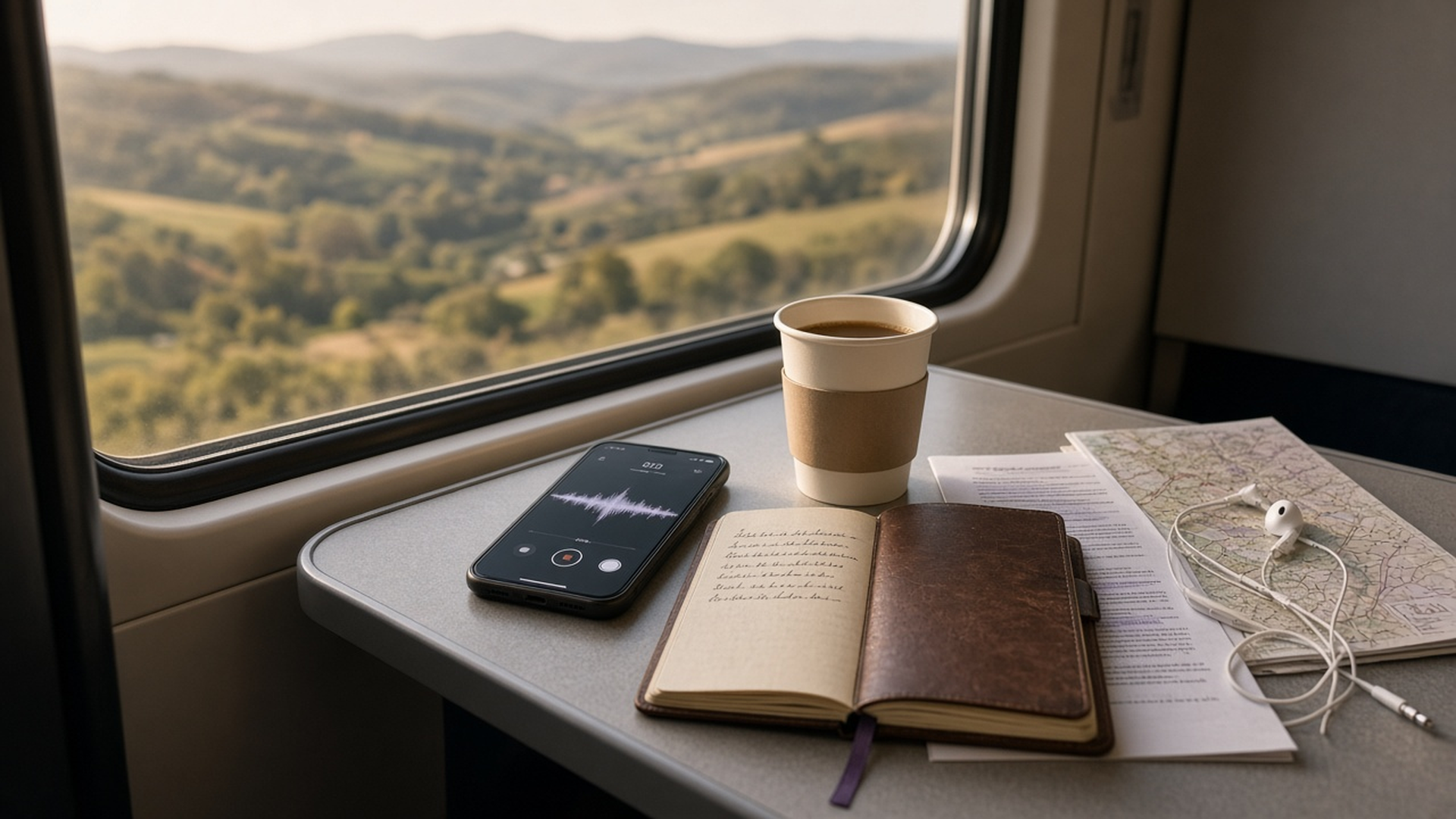
Almost everyone who travels has the same small ambition: this time, I will keep a journal. A real one, with dates and places and the name of that restaurant down the alley that you swear you will recommend to friends.
It lasts about three days. Then the notebook stays in the bag, the evenings get long, and writing by hand after twelve kilometers of walking feels like homework.
What often happens instead is quieter and more interesting. You start talking into your phone. On a train platform, you record a minute about the strange breakfast. On a balcony at night, you describe the view because a photo cannot hold the sound of the street. In a taxi, you say the name of a village out loud so you will not forget it.
Those clips are the journal you meant to keep. They are just in a format you will almost never open again.
Why voice memos are such good raw material
Spoken notes have a quality that written travel journals usually lack. They are immediate. You record them in the moment, not the evening after, so they carry details that disappear quickly: the price of the bus ticket, the joke the guide told, the exact way the old man at the market pronounced the name of a fruit.
They are also honest. When you write, you edit yourself into a slightly more composed traveler. When you talk, you admit that you are lost, that the famous museum was a bit boring, that the best part of the day was a sandwich. That is the material people actually want to remember later.
And they are cheap. Recording a voice memo costs ten seconds and no effort. That is exactly why people keep doing it long after the paper journal has been abandoned.
Why nobody plays them back
The problem is not recording. The problem is retrieval.
A month after the trip, your phone holds forty clips named "New Recording 17" through "New Recording 56." Each is between thirty seconds and six minutes long. Some are about museums, some are reminders to buy a charger, one is two minutes of wind. To find the name of that restaurant, you would have to listen to all of them, in order, at the speed you spoke them.
Nobody does that. Audio is a format you can only move through in real time. You cannot skim it, you cannot search it, and you cannot glance at it on a page and see that the third paragraph is the one about the harbor. So the clips sit there, technically saved and practically lost, until the next phone upgrade quietly leaves them behind.
What changes when the memos become text
Turning those recordings into transcripts does not sound romantic. But it changes the relationship you have with them completely.
You can read the whole trip in ten minutes. Forty clips that would take two hours to listen to become a few pages you can scroll through over a coffee. The trip reappears in order, in your own voice, with the small details intact.
You can search it. Type "restaurant," "train," or the name of a town, and you find the exact moment you mentioned it. The recommendation you promised a friend is no longer buried in minute four of a clip about something else.
You can edit it into something. A transcript is a rough draft. Cut the wind, the "um, where was I," and the reminders about chargers, and you are left with a surprisingly readable account of the journey. Many people find that a few light edits turn a pile of memos into a travel journal that reads better than anything they would have written by hand.
You can share it selectively. A clean paragraph about a hike is easy to paste into a message, a blog post, or a photo caption. A two-minute audio file is not something most friends will press play on.
It lasts. Text files are small, durable, and survive changes of phone, app, and cloud account. Ten years from now, a folder of text documents is far more likely to be readable than a scattered collection of audio files in a format that may or may not be supported.
A simple way to make it a habit
You do not need a strict system. A loose routine works better, because travel rarely follows a schedule.
- Record freely during the day. Do not worry about structure. Say where you are and roughly what time it is at the start of a clip, and the rest will make sense later.
- Transcribe in batches. Every few days, or on the flight home, run the new recordings through a transcription app. Doing it in batches keeps it from becoming a chore.
- Add a heading per day. Group the transcripts by date and place. That small act of organization is enough to turn fragments into a narrative.
- Keep the audio too. The transcript is for reading and searching. The original recording is for the rare moment when you want to hear the street noise or a friend laughing in the background.
- Do one editing pass when you are home. Read through the whole trip once, clean up the obvious filler, and mark the passages you want to keep or share.
That is it. No daily writing quota, no guilt about the abandoned notebook.
It works for more than holidays
The same idea applies to any journey where you talk more than you write. Work trips, where you record impressions after a client visit. Long drives, where speaking is the only safe way to take notes. Family visits, where an older relative starts telling stories about the town they grew up in. Research trips, where field observations are far easier to dictate than to type with cold hands.
In each case, the recording captures the moment, and the transcript is what lets you return to it.
The trip is already recorded
Most people think of a travel journal as something they failed to keep. Often, it is something they kept without noticing. The details, the observations, the half-formed thoughts on the train are all there, sitting in a voice memo folder.
The only missing step is making them readable. Once the memos become text, the trip becomes something you can reread, search, and share, rather than something you vaguely remember and promise yourself you will listen to someday.
If you want to turn your own travel recordings into text, To The Text transcribes voice memos, audio files, and videos on your iPhone, so the journal you spoke is ready to read when you get home.