You Forgot Half of What the Doctor Said
Most of what you hear in a medical appointment is gone by the time you reach the car. Recording the conversation (with permission) and turning it into text gives you something you can reread, check, and share with the people helping you.
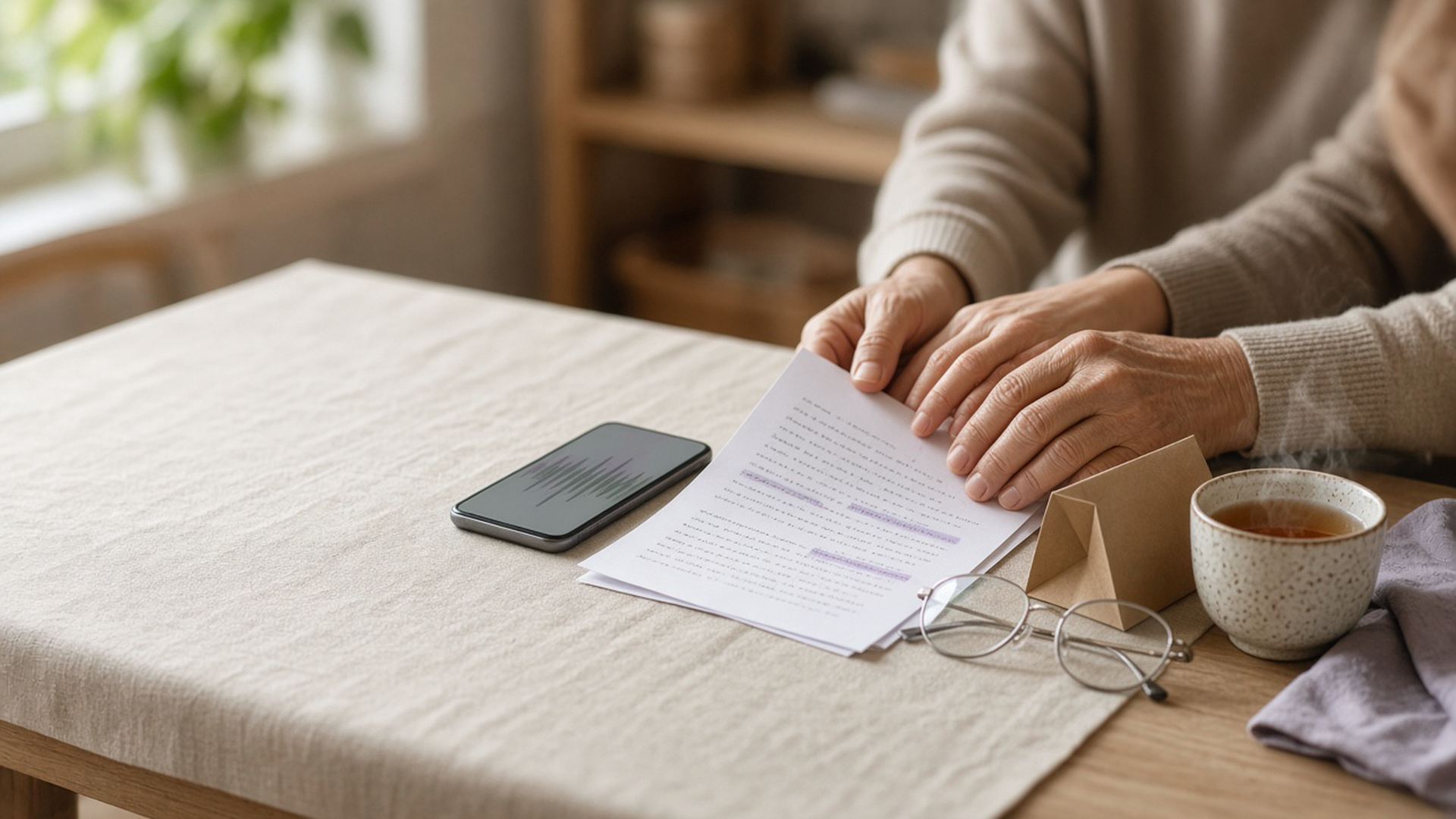
You leave the appointment feeling fine. The doctor was clear, you nodded at the right moments, and you even asked a question.
Then you get to the car and someone asks, "So what did she say?"
And you hear yourself say: "It's probably nothing. Something about a new pill. We're supposed to come back in… a few weeks? Or after the blood test?"
That is not a failure of intelligence. It's what happens to almost everyone.
Memory is the weakest part of the visit
A medical appointment is close to the worst possible setting for remembering things. You're nervous. You're half-dressed or in pain. The conversation is fast, full of unfamiliar words, and the most important sentence often comes in the last minute, while the doctor is already standing up.
Researchers have known this for a long time. A widely cited review of patient memory in the Journal of the Royal Society of Medicine summarized it bluntly: somewhere between 40 and 80 percent of medical information is forgotten almost immediately, and close to half of what people do remember is remembered incorrectly. The more information you're given, the smaller the share you keep.
So the problem isn't that you weren't listening. The problem is that a conversation is a terrible place to store instructions.
Notes help, but they're a rewrite
The usual advice is to bring a notebook. It's good advice, and it still has a gap.
When you write during an appointment, you're doing two hard things at once: understanding new information and compressing it into a few words. You end up with lines like "BP med — change?" or "scan if not better." They made sense in the room. A week later, they're riddles.
And the moment you're writing is the moment you're not listening. The doctor explains the side effect to watch for while you're still spelling the name of the medication.
Notes capture what you managed to catch. A recording captures what was actually said.
Recording is easy. Rereading is what helps.
Most people already carry the tool. Put the phone on the desk, ask if it's okay to record, and press start.
But an audio file on its own has the same weakness as every other recording: nobody wants to scrub through twenty minutes to find the sentence about the dose. Studies of patients who were given recordings of their consultations have found real benefits, including better recall and feeling better informed, as a systematic review of consultation recording for patients over 50 found. In one UK general-practice trial, about a quarter of the people who listened back noticed information they hadn't heard during the visit itself.
A transcript makes that kind of review fast. Instead of listening again, you read. Instead of guessing, you search.
- Find the instructions. Search for "twice a day," "fasting," or "call us if," and land on the exact sentence.
- Check the words you didn't catch. The name of the condition, the test, the medication. Spelled out on a page, you can look them up properly instead of typing half-heard syllables into a search bar.
- See what was decided, and what wasn't. Was the scan ordered, or only mentioned as a maybe? The transcript shows the difference between "we'll do" and "we could do."
- Prepare the next visit. Reread before the follow-up and write down what still isn't clear.
It matters most when you're not the patient
A lot of medical conversations are now shared work. An adult child goes with a parent. A partner sits in on a specialist visit. A sibling who lives in another city wants to know what was said, in words, not in a worried phone summary.
This is where text quietly beats both memory and audio. You can paste the important part into the family chat. You can print a page for a parent who doesn't use voice messages. You can translate a paragraph for a relative who doesn't speak the language the doctor spoke.
It also stops a familiar argument: three people leave the same appointment with three different versions of what the doctor said. With a transcript, nobody has to win. You just look.
A simple routine for appointments
Nothing here needs special equipment.
- Write your questions before you go. Three or four, in order of importance. Put the most important one first, not last.
- Ask before you record. Something like: "Do you mind if I record this so I can listen again later? I tend to forget the details." Most clinicians are used to it. If they say no, respect it and take notes instead. Rules and clinic policies differ from place to place, and recording without permission is the fastest way to damage the relationship with someone you need to trust.
- Put the phone flat on the desk. Close to the conversation, away from rustling paper and the keyboard.
- Ask for the summary out loud. Near the end: "Can you repeat the main things I should do?" That gives you one clean paragraph in the transcript with everything in it.
- Transcribe the same day. Before the details blur and before the file disappears into your camera roll.
- Highlight three things. What to do, what to watch for, and when to come back.
Here's a hypothetical example of what that last step can look like:
| What the transcript says | What you do with it |
|---|---|
| "Take it in the morning, with food, starting tomorrow." | Set a reminder for breakfast |
| "If the swelling gets worse or you get a fever, call us." | Put it on the fridge |
| "Let's repeat the blood test in six weeks, then decide." | Book the test today, not later |
| "We could also consider physiotherapy." | A question for next time, not a decision |
That table takes five minutes to make. It saves the evening of "wait, did she say with food?"
Keep it private
A recording of a medical appointment is about as personal as data gets. Treat it that way.
Keep the audio and the transcript in a place you control, share only the parts people need, and delete what you don't want to keep. If you share a passage with family, share the passage, not the whole file.
And a transcript doesn't replace your clinician. If something in it confuses or worries you, the right move is to call and ask, with the exact sentence in front of you. That's a much better conversation than "you said something about my kidneys?"
A recording keeps what the doctor said. A transcript lets you actually find it when it matters.
Soft close
Nobody expects you to remember a lecture you heard while anxious, half-dressed, and sitting on paper. Doctors know it. Researchers have measured it. The fix is ordinary: keep the words, and turn them into something you can read.
Next appointment, ask if you can record. Then turn it into text the same day.
To The Text on iPhone can turn those recordings into readable, searchable text, so the instructions are still there when you get home.