You Can't Code a Recording
Qualitative research lives on patterns across interviews, and patterns only show up on the page. Here's why turning research recordings into transcripts is the step that makes analysis possible.
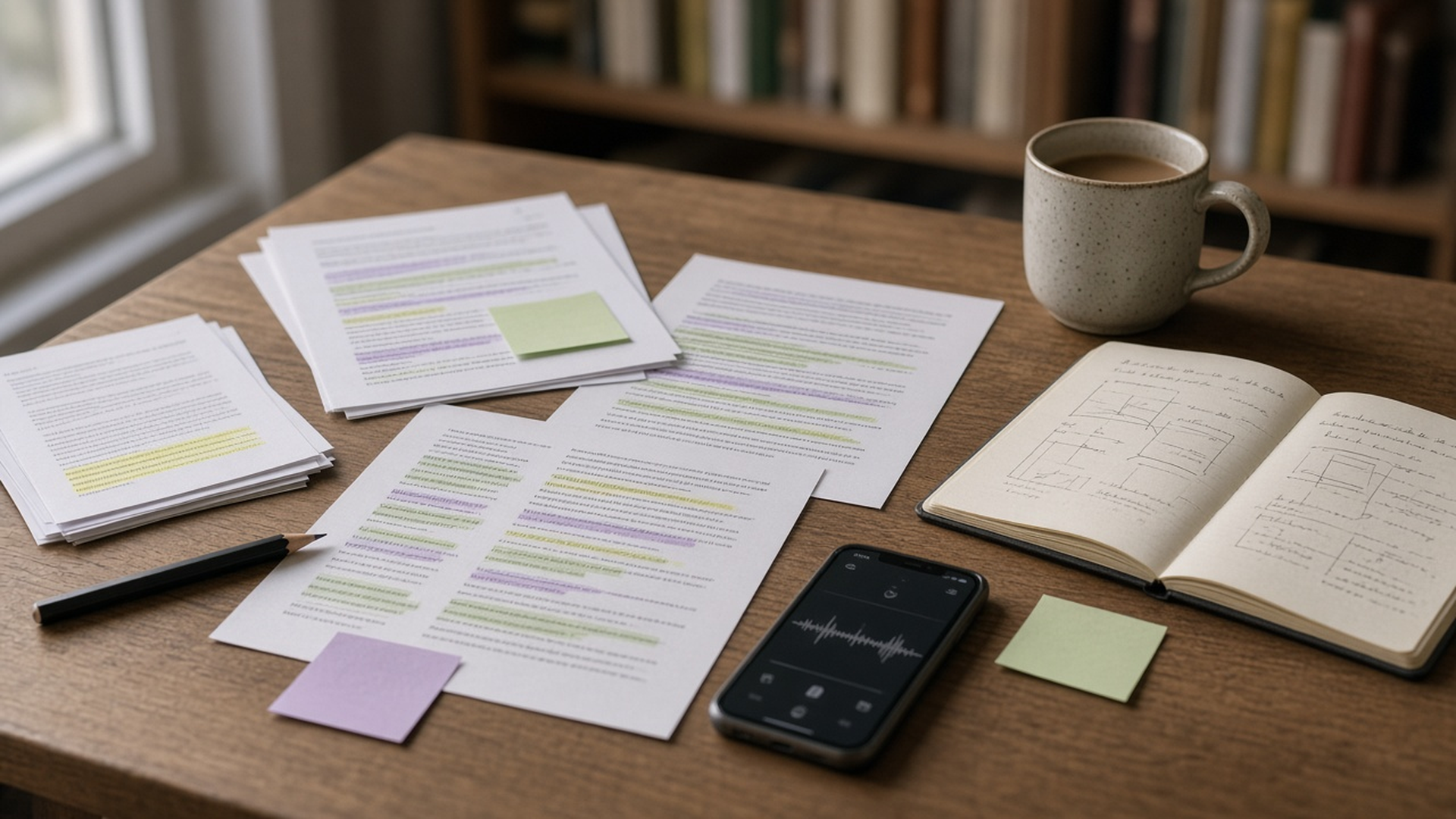
You ran twelve interviews. Maybe they were user research sessions, maybe thesis fieldwork, maybe conversations with nurses about a new shift system. Now you have twelve hours of audio and a strong feeling about what people said.
A feeling is not a finding.
Somewhere in those recordings are the patterns you went looking for: the complaint that came up in nine of twelve conversations, the workaround three people described in almost the same words, the topic nobody mentioned even though you expected everyone to. You can't see any of that by listening. You can only see it on the page.
That's the quiet rule of qualitative work: you can't code a recording. You can only code text.
What "coding" actually means
In qualitative research, coding is the unglamorous heart of analysis. You go through your material line by line and tag passages with short labels: trust in the tool, time pressure, workaround, blames the manager. Then you look across all your interviews and ask which labels keep appearing, which cluster together, and which contradict each other.
Whether you call it thematic analysis, affinity mapping, grounded theory, or just "going through the notes," the mechanics are the same:
- Read a passage.
- Decide what it's about.
- Mark it.
- Compare it with every other passage that got the same mark.
Every one of those steps assumes you can point at the exact words. "Participant 7 said something about trust around the middle" is not a code. "P7, line 214: I just stopped believing the numbers it gave me" is.
Why listening doesn't work
People try to analyze straight from audio all the time, usually because transcription feels like a chore standing between them and the interesting part. It almost always goes wrong in the same few ways.
Memory picks the vivid moments. The participant who got emotional, the one who told a great story, the one who disagreed with you. Those stick. The quiet, repeated, boring observations that actually make up a pattern slide right past. You end up reporting what was memorable instead of what was common.
You can't compare across hours. To check whether two people described the same problem, you need both passages side by side. With audio, that means scrubbing through two files, holding one quote in your head while hunting for the other. Do that for fifty codes across twelve interviews and you'll give up long before you finish.
Your notes are already an interpretation. Notes taken during or after a session capture what you thought was important at the time. But analysis is supposed to happen after you've heard everyone. The fifth interview often changes what the first one meant, and your first-interview notes can't be re-read in that new light. A transcript can.
Nothing is quotable. Research reports live on direct quotes. A paraphrase from memory is weaker evidence, and as anyone who has checked one knows, it's often wrong in ways that matter.
The transcript is the dataset
Once your interviews are text, the whole job changes shape. The recordings stop being a pile of hours and start being a dataset you can actually work with.
You can read at your own pace, rereading a confusing answer three times without touching a playback bar. You can search every interview for "spreadsheet" or "my manager" or "I gave up" and see every hit in seconds. You can highlight and tag directly on the page, in a document, a spreadsheet, or a dedicated analysis tool. And you can pull quotes with confidence, because the exact words are sitting right there.
Maybe most importantly, you can see absence. One of the most useful findings in research is the thing nobody said. If you expected people to mention price and nobody did, that's a result. You can only notice it reliably when you can scan all the text and confirm that the word never shows up.
A practical workflow
You don't need a research lab to do this well. A simple, repeatable process is enough:
- Record with consent. Tell participants why you're recording and what happens to the file. Note the date and a participant ID rather than a full name if anonymity matters.
- Transcribe soon after. Do it the same day if you can, while the conversation is still fresh enough for you to fix the odd misheard word.
- Clean lightly, not heavily. Fix names, jargon, and obvious errors. Leave the hesitations and false starts in at first. "I mean, it's fine, I guess" reads very differently from "It's fine."
- Label speakers and add line numbers or timestamps. You'll want to cite "P4, 12:30" later, and you'll want to jump back to the audio for tone when a passage is ambiguous.
- Do a first read with no codes. Just read everything once. Jot down impressions in the margin. This is where you get the feel for the whole set.
- Code in passes. Start with obvious, descriptive codes, then go back and look for the more interpretive ones once you know the material.
- Build a quote bank. Copy your strongest passages into one document, grouped by theme, each with its participant ID. When it's time to write the report, half of it is already done.
The step people skip is number two. Transcribing weeks later, or "when there's time," is how a research project quietly turns into a set of impressions.
Keep the audio, but don't work from it
None of this means the recording is useless. Tone matters. Sarcasm, a long pause before an answer, a laugh that undercuts the words: those are real data, and sometimes you need to go back and hear them.
The trick is to treat the audio as a reference and the transcript as your working surface. When a line feels ambiguous, the timestamp takes you straight to that moment. You listen for ten seconds, add a note, and you're back in the text. That's very different from trying to analyze by listening, which means hours of playback for every question you ask.
Not just for academics
This applies well beyond university research:
- Product teams running customer interviews and usability sessions.
- Journalists working on a long feature with a dozen sources.
- HR and people teams collecting feedback in exit or stay interviews.
- Nonprofits and public services listening to the communities they serve.
- Founders doing discovery calls and trying to tell real demand from polite interest.
Anywhere you're trying to find out what a group of people actually think, the same rule holds. The insight is in the pattern, and the pattern is in the text.
From hours of audio to something you can read
The honest reason people skip transcription is that it used to be slow and expensive. That's no longer true. Turning an hour of interview into text now takes minutes, which removes the main excuse for analyzing from memory.
If you record research interviews on your iPhone, To The Text turns audio and video into clean, searchable transcripts you can export, highlight, and code. Record the conversation, then do your analysis where it belongs: on the page.