You Can't Bookmark a Waveform
Timestamps, screenshots of players, and mental notes feel like saving a moment in audio. They aren't bookmarks. A transcript is the only place you can mark a line and find it again without scrubbing.
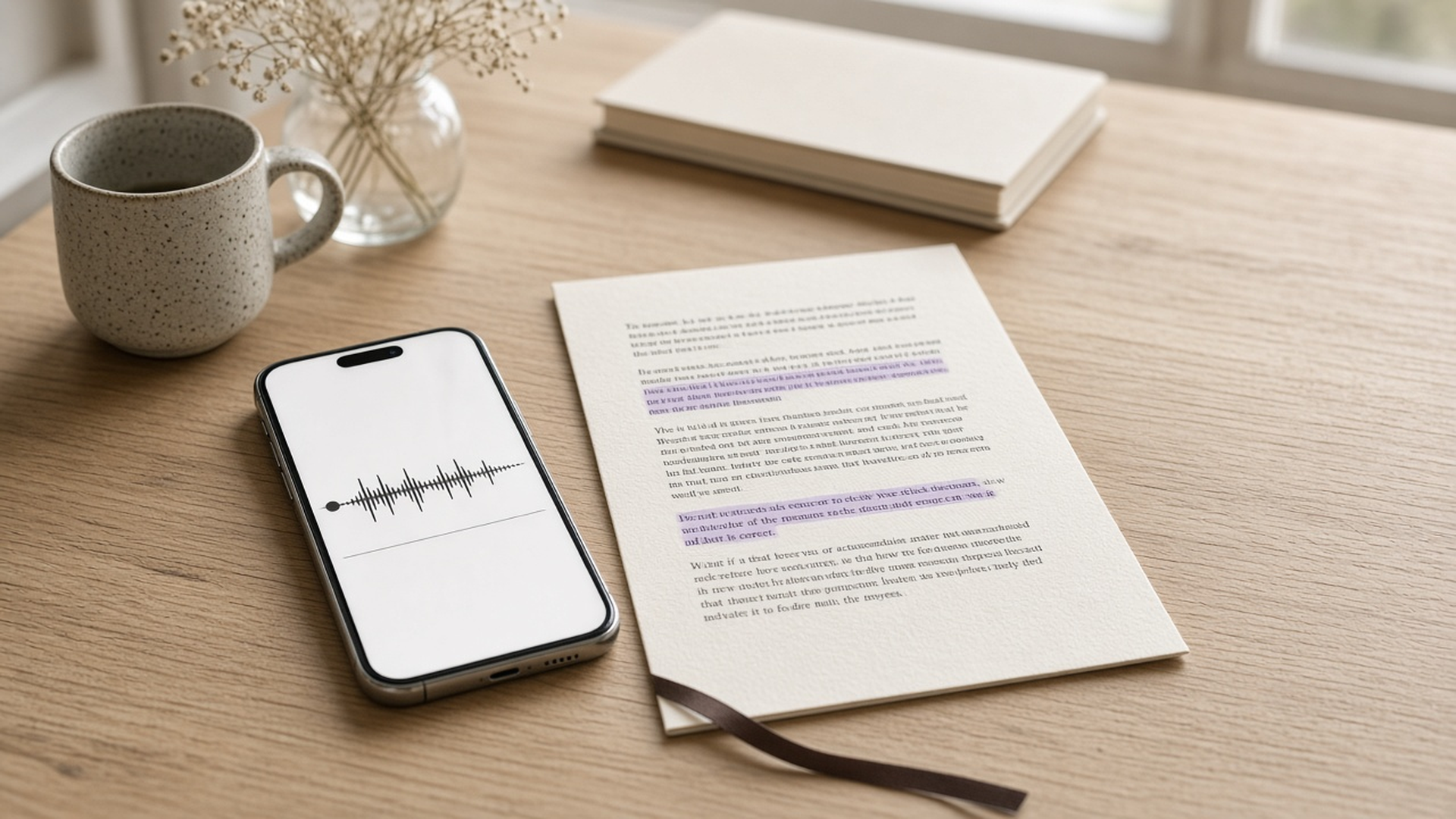
You found the line. Midway through a podcast, a customer call, or a lecture, someone said the exact thing you need later. You tapped pause. You squinted at the scrubber. You typed 14:32 into a note, or took a screenshot of the player, or swore your brain would keep the place.
A week later you open the file and the bookmark is gone. The timestamp still exists. The meaning does not. You scrub. You guess. You listen at 1.5x while half-watching Slack. You give up and quote a blurrier version from memory.
You never bookmarked the idea. You bookmarked a position on a waveform.
A bookmark is a place you can return to
In a book, a bookmark is honest. The page stays put. The sentence is still there. You open to the ribbon, read the line, and keep going.
In a document, a highlight is even better. You search, you jump, you copy. The mark is attached to words, not to a clock.
Audio has none of that. A waveform is a picture of loudness over time. The "important bit" is not a shape you can recognize next Tuesday. It is a few seconds of speech that only make sense when you hear them again — which is exactly the work you were trying to avoid.
So 14:32 is not a bookmark. It is a scavenger hunt with a starting hint.
The fake bookmarks we invent
People get creative because the need is real.
Timestamps in notes. Useful if the file never changes and you always reopen the same player. Useless when the recording is re-exported, trimmed, or opened in a different app that counts time differently. Even when the number is correct, you still have to listen to know whether you landed on the right sentence.
Screenshots of the player. You capture a scrubber and a title. Next week you have a JPEG of a UI. The words are not in the image. The image cannot be searched. You have memorabilia, not a reference.
"I'll remember where it was." You will remember the vibe. You will not remember the clause. Memory edits. Transcripts do not.
AI summaries as stand-ins. A summary can mention that "budget came up." It usually will not preserve the exact sentence you wanted to paste into a ticket. Summaries decide what mattered. Bookmarks need the raw line available.
Each of these feels like capture in the moment. Each fails the only test that matters: can you get back to the same words in under thirty seconds without scrubbing?
Why waveforms resist marking
Video and audio are timelines. Documents are random-access. Knowledge work is almost entirely random-access.
You do not re-read a PDF from page one every time you need a quote. You search. You skim headings. You jump. The format assumes you will arrive mid-stream.
Players assume the opposite. They optimize for continuous experience — play, pause, skip fifteen seconds. That is great for first listening. It is a terrible interface for returning.
So the moment you care about becomes a needle in a continuous stream. Your "bookmark" is a guess about where the needle might be. The cost of being wrong is replaying the neighborhood until something sounds familiar. That cost is why most saved timestamps quietly die unused.
What a transcript turns into a bookmark
Transcribe the recording and the same moment becomes a different object.
Now you can:
- Highlight the exact sentence
- Search for the phrase you half-remember
- Copy the line into Slack, Notion, or a ticket
- Link a colleague to words instead of a "start around fourteen minutes" instruction
- Return months later without depending on the original player
The audio can stay. Keep it for tone, pacing, and anything the voice carries that text softens. Attach timestamps in the transcript if you want jump-back for the hard parts. The point is not to delete the recording. The point is to stop pretending the scrubber is a filing system.
The transcript is the page. The waveform is the performance attached to it.
A better habit when something matters
You do not need a perfect system. You need a default that survives next week.
- When you hear the line, mark intent, not only time. A one-word note like "budget quote" is fine — but treat the timestamp as temporary, not as the archive.
- Transcribe the file the same day you care about it. Same-day matters. The urge to "just save the time code" is strongest right after you hear the line, and that is also when transcription is cheapest emotionally.
- Highlight or excerpt the sentence in text. That is the bookmark. Everything else is backup.
- Link the audio only when hearing it still matters. Demos, interviews, and tone-sensitive feedback benefit from the recording. Most "I need that sentence" tasks do not.
This is not extra work on top of listening. It is how listening becomes reusable.
Where timestamps still help
Timestamps are not useless. They are incomplete.
They help when:
- You are editing video and need frame-accurate cuts
- You are sharing a clip and the player supports deep links
- You already have a transcript and want one-click jump to the spoken moment
In those cases the time code is a pointer into a document you also have. Alone, it is a pointer into fog.
Two traps that look responsible
Trap one: a folder of "important moments" as screenshots. You will never search them. You will never paste from them. You will feel organized until you need one line.
Trap two: relying on the platform's "chapters" or auto-highlights. Chapters are someone else's outline. Auto-highlights are a model's guess. Neither replaces having the words on a page you control — especially when the platform changes, the episode disappears, or the call recording expires.
Responsible capture means the words can leave the player.
What this looks like when it works
You are writing a proposal and remember a customer said something sharp about onboarding. You search last month's call transcript for "two-week implementation." The sentence is there, highlighted from the day you heard it. You paste it. You do not reopen the Zoom file.
Or a teammate asks where the decision about pricing was spoken. You send a paragraph, not a "around the forty-minute mark" apology. They read it in twenty seconds.
Or you return to a lecture before an exam. Your notes are not a cemetery of time codes. They are sentences you can skim, with the recording linked for the parts that need the professor's voice.
Soft close
Waveforms are honest about loudness. They are silent about meaning.
A bookmark has to attach to something stable and quotable. On a page, that is a sentence. On a scrubber, that is a hope.
Listen when listening is the point. When you need to return, put the words somewhere a highlight can live. Keep the audio for the moments that still need sound. When next week asks for that line, open a document — not a scavenger hunt.
To The Text on iPhone turns calls, podcasts, and voice recordings into searchable text — so the moment you cared about becomes a line you can highlight, not a timestamp you have to survive.