The Wedding Toasts Live on Someone's Phone
The best words at a wedding are usually spoken once, in a noisy room, and recorded by a guest. A transcript turns those toasts, vows, and speeches into something the couple can actually keep and reread.
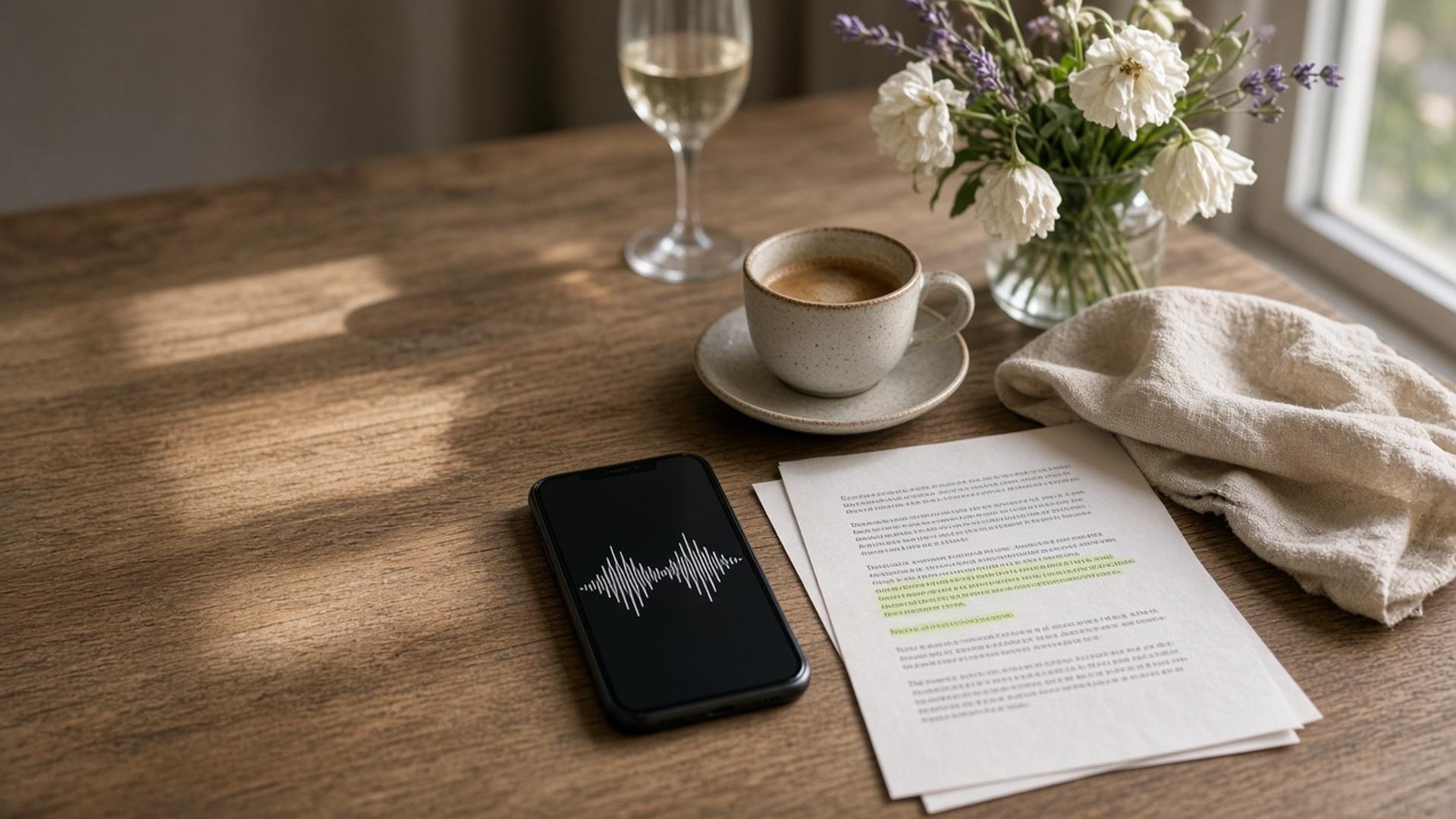
Ask a couple a month after the wedding what they remember about the speeches, and you tend to get the same answer. They remember that the best man was funny. They remember that the maid of honor made everyone cry. They remember a line about a road trip, or a dog, or the night they met, but they cannot quite reconstruct it.
They were there. They were the subject of every sentence. And still the words have mostly gone.
This is not a failure of attention. A wedding is a day of being pulled in six directions, and the speeches arrive somewhere between the second glass of wine and the moment someone needs you for a photo. You hear them with your heart, not with a notebook. That is how it should be.
But the words people spent weeks writing deserve better than being heard once.
Where the speeches actually end up
Most weddings now have a photographer, often a videographer, and a hundred guests holding phones. You would think the speeches are well documented. Usually they are not, at least not in a form anyone uses.
The professional video, if there is one, tends to arrive months later as a polished highlight reel set to music. The speeches are trimmed to a few emotional seconds. The full, unedited footage might exist on a drive somewhere, but it is long, and nobody sits down to watch ninety minutes of reception audio for fun.
The more honest record is scattered across guests' phones. An aunt filmed the father of the bride. A college friend caught the first half of the best man's speech before her battery died. Someone in the back recorded the vows on a voice memo because they could not see over the crowd. These files exist. They are just in the wrong places, in the wrong format, and mixed in with everything else that happened that day.
A recording that lives in a stranger's camera roll is technically saved. It is not really kept.
Why video is the wrong format for remembering words
Video is wonderful for faces, for laughter, for the way someone's voice cracks on a particular sentence. It is a poor format for the words themselves.
You cannot skim a video. You cannot find the line about the road trip without scrubbing back and forth. You cannot copy a sentence into a card, a photo book, or an anniversary message. You cannot read it on the train. And as the years pass, the files drift: phones get replaced, cloud accounts lapse, a shared album link stops working.
Text is the opposite. A page of text is small, durable, and easy to move. It survives format changes. It can be printed, framed, pasted, or tucked into the back of an album. It is also the format people reach for when they actually want to revisit something. Nobody rewatches a toast to find one phrase. They would happily reread it.
What a transcript gives a couple
Turning wedding recordings into text sounds like an administrative chore. In practice, it is closer to a gift.
The vows, in your own words. Many couples write their own vows and then deliver them from a phone or a crumpled card. The spoken version is almost always different from the draft. People improvise, add a line, skip one, laugh in the middle. The transcript captures what was actually promised, not what was planned.
Speeches you can reread on a hard day. The people who give toasts are often the people who know a couple best. What they say is a portrait: how the couple met, what friends see in them, what they hope for. That is worth rereading long after the wedding, and much easier to reread than to rewatch.
Lines for the photo book and the thank-you cards. If you want to put a quote from the father of the bride under a photo of him, you need the exact words. Memory will give you a paraphrase. A transcript gives you the sentence.
A record of the people who are not there anymore. This is the quiet reason. Grandparents give blessings. Parents give speeches. Years later, those recordings become some of the only places their voices and words survive. A transcript does not replace the voice, but it makes the words findable, shareable, and harder to lose.
How to collect the recordings before they scatter
The window to gather wedding recordings is short. Within a few weeks, guests have moved on, phones have filled up, and files start disappearing. A little effort early saves a lot of searching later.
Ask early and make it easy. A week after the wedding, send one message to the people you know were filming: "If you recorded any of the speeches, could you send me the file?" Give them a single place to drop it, like a shared folder.
Ask for the original file, not a forward. Messaging apps often compress video and audio. A heavily compressed clip is harder to transcribe cleanly. If possible, ask guests to share the original from their photos app.
Prefer the clearest audio, not the best picture. For the words, the guest who stood near the speaker matters more than the one with the perfect angle. A shaky clip close to the microphone usually beats a steady wide shot from across the room.
Collect overlapping recordings. If two people caught the same speech, keep both. One may have a cleaner start, the other a cleaner end. Together they give you a complete version.
Turning noisy recordings into readable text
Reception audio is not studio audio. There is clinking, laughter, applause, a DJ waiting for his cue. Transcription will not be perfect on every word, and that is fine. The goal is a readable record, not a court document.
A few habits help:
- Transcribe each speech separately. Trim long recordings to the toast itself before you transcribe. It keeps the result focused and easier to edit.
- Clean lightly, not heavily. Fix names and obvious mishearings. Leave the "you know" and the pauses alone where they carry the speaker's rhythm. It should still sound like them.
- Add a small header. Who spoke, their relationship to the couple, and roughly when. In twenty years, "Speech 3" will mean nothing. "Uncle Mark, father of the groom, after dinner" will.
- Mark laughter and applause sparingly. A simple "(laughter)" after the best joke tells a future reader where the room was.
Once the speeches are text, put them somewhere boring and permanent: a document in your files, a printed copy with the wedding album, a page in a notebook. Boring is good. Boring lasts.
The words were the point
People prepare for weeks to speak for three minutes at a wedding. They rewrite their openings, cut jokes, practice in the car. Then they deliver it once, to a room that is half listening and half looking for the bar, and the moment is gone.
The couple deserves to keep what was said, in a form they will actually revisit. Not as a ninety-minute file on a drive, and not as fragments in other people's phones, but as words on a page they can read again on their anniversary, share with their kids, or quietly return to when they miss someone.
The recordings are already out there. The only step left is turning them into something you can read.
If the toasts, vows, or speeches are sitting on your iPhone, To The Text can turn those videos and voice memos into transcripts you can edit, copy, and keep, so the words people gave you on the day do not stay buried in a camera roll.