The Lyric You Mumbled at 2 a.m.
Songwriters fill their phones with voice memos of half-sung ideas, then never find them again. Here's why transcribing those memos turns a pile of hums into a lyric notebook you can actually write from.
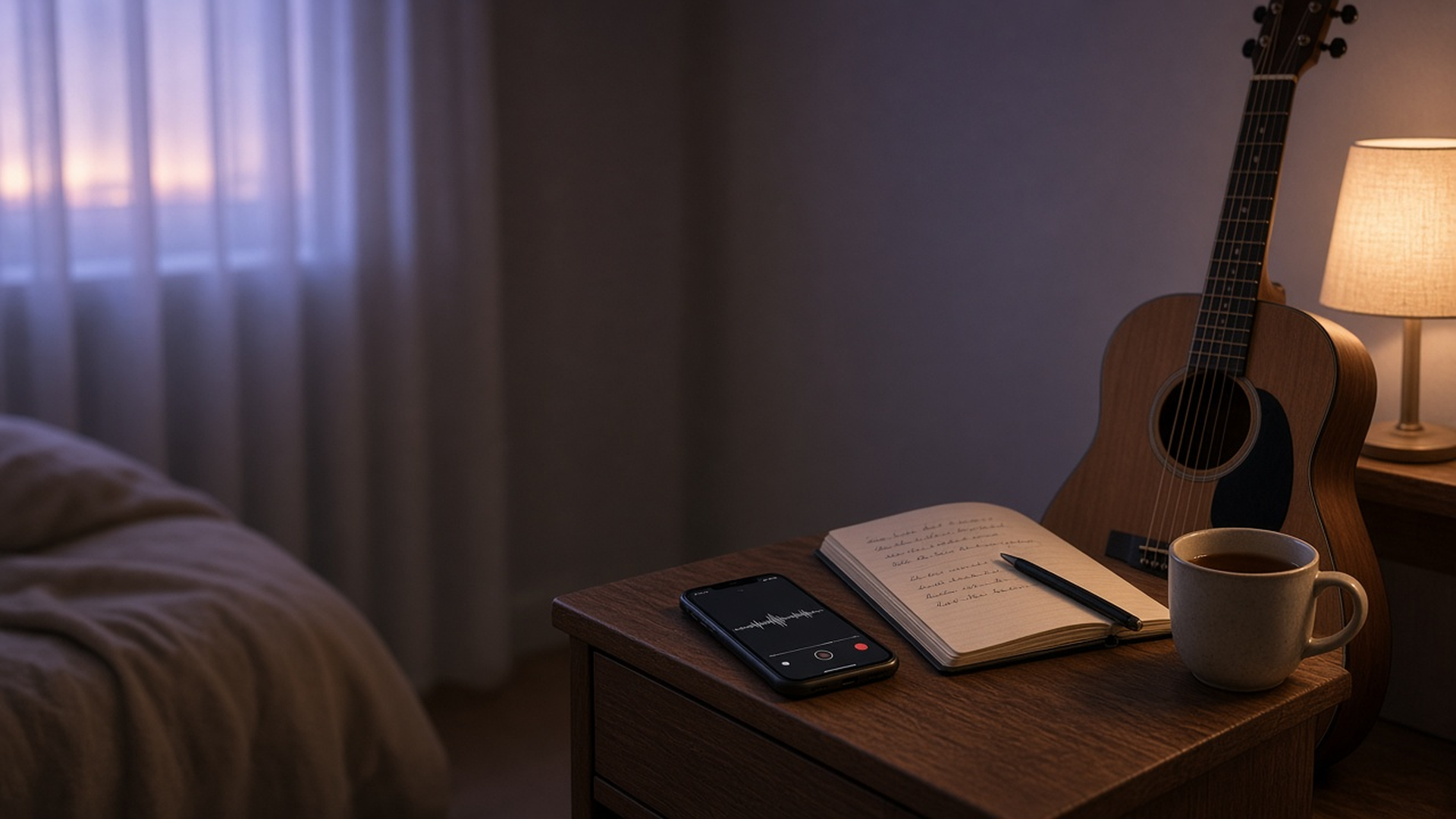
It's late. You're half asleep, and a line arrives out of nowhere, already attached to a melody. You grab your phone, hit record, and sing it quietly so you don't wake anyone. Then you go back to sleep, pleased with yourself.
In the morning, the memo is called "New Recording 214." It sits between "New Recording 213," which is you humming in a car, and "New Recording 215," which is eleven minutes of a rehearsal you forgot you recorded.
A year later you have four hundred of them. Somewhere in that list is the best line you ever wrote. You just can't find it, because you can't read it.
Voice memos are the songwriter's notebook. But a notebook you can't flip through isn't much of a notebook.
The phone became the place ideas go
Most songwriters, from bedroom producers to people who write for a living, capture ideas the same way now. Not on napkins, not in leather journals, but in the voice memo app. It's always in your pocket, it catches melody and rhythm along with the words, and it takes one tap.
That's genuinely a gift. Singing an idea preserves things writing never could: the phrasing, the stress on a syllable, the way a line wants to land on the beat. A written lyric loses all of that.
But the trade-off is quiet and brutal. Audio is easy to capture and hard to revisit. To find a line, you have to remember roughly when you recorded it, guess which file it's in, and listen. Most people give up after a few files. The ideas don't get lost in one dramatic moment. They just drift out of reach.
Why you stop going back
Songwriters often talk about "mining the memos" as if it's a regular habit. In practice, it's a chore that gets postponed forever. A few reasons:
- The names are useless. Dates and numbers tell you nothing about what's inside.
- Listening is slow. Ten minutes of rehearsal takes ten minutes to check, and the good bit might be nine minutes in.
- You hate hearing yourself. Rough takes are rough. Many writers avoid their own memos for the same reason people avoid their voicemail greeting.
- There's no overview. You can't glance across a hundred recordings and notice that you keep circling the same image, or that three fragments from different months belong in one song.
That last point matters most. A lot of songwriting is connection: a verse from March meeting a chorus from August. Audio files keep every fragment sealed in its own little box. Nothing touches anything else.
What changes when the memo becomes text
Transcribing a voice memo doesn't replace the recording. You still keep the melody and the feel. What it adds is a layer you can read, and reading is fast in a way listening never is.
Suddenly you can:
- Scan a month of ideas in minutes. A page of transcribed fragments reads like a messy, honest lyric notebook.
- Search for a word. Remember a line had "harbor" in it? Search, and there it is, along with the date, so you can go straight to the right audio.
- Rename files with meaning. Once you can see the first line, "New Recording 214" becomes "harbor lights, slow verse idea."
- Spot patterns. Images and phrases you keep returning to jump out when they're on the page together. That's often where your next song is hiding.
- Copy and rearrange. Paste fragments into one document, shuffle them, cut lines, try verse orders. Text invites editing. Audio doesn't.
The transcript won't be perfect for sung parts. Sung words stretch and blur, and a mumbled 2 a.m. take is hard for anyone to decode, human or machine. But even an imperfect transcript is a map. It tells you what's in the file and where, and that's usually enough to send you back to the audio for the exact phrasing.
Talking about the song is worth catching too
Not every useful memo is singing. Many writers also talk into their phones: "Okay, idea for the bridge, it should feel like the moment after an argument, quieter, maybe drop the drums." Or a co-writing session where someone says the perfect line in passing and nobody writes it down because everyone is busy laughing.
Spoken notes like these transcribe very well, and they're often the most valuable part. They capture intent: what the song is supposed to feel like, why a section exists, what you were going for before the details took over. Months later, when you pick the song back up, that's exactly what you've forgotten.
Co-writes are a special case. Sessions usually run long, wander a lot, and produce a few golden lines in the middle of a lot of chatter. A transcript of the whole session lets everyone see what was actually said, which ends the familiar argument of "I'm sure we had a better second line" and also makes it much clearer who came up with what.
A simple habit that works
You don't need a complicated system. Something like this is enough for most people:
- Keep recording the way you already do. Don't let any process slow down the moment of capture. The idea comes first.
- Transcribe in batches. Once a week, run the week's memos through transcription. It takes minutes, not an evening.
- Collect the text in one place. A single running document, or one note per song idea. Paste each transcript with its date.
- Mark the keepers. Highlight lines that still give you something. Ignore the rest without guilt.
- Go back to the audio only for the winners. Now you know exactly which files are worth listening to.
The point is to separate two jobs that fight each other. Capturing should be instant and messy. Reviewing should be calm and readable. Voice memos are perfect for the first job and terrible at the second. Text fixes the second.
Your past self is a co-writer
There's a reason so many writers say their best material came from old notebooks. The person who wrote those scraps wasn't trying to finish anything. They were just noticing things, and noticing is the raw material of songs.
Your voice memos are that notebook, only louder and harder to open. Every one of them is a small message from a version of you who was paying attention at 2 a.m., in the car, in the shower, halfway through a conversation. Turning those messages into text is how you actually read them. And reading them is how fragments finally become songs.
If your phone is full of half-sung ideas and spoken song notes you never revisit, To The Text turns voice memos and recordings into clean, searchable text right on your iPhone, so you can read through your ideas, find the lines worth keeping, and start writing from them.