The Kickoff Call Never Made the Brief
Project kickoff calls are packed with scope, assumptions, and quiet constraints that rarely survive into the written brief. Transcribing the recording turns a one-hour conversation into a document the whole team can trust.
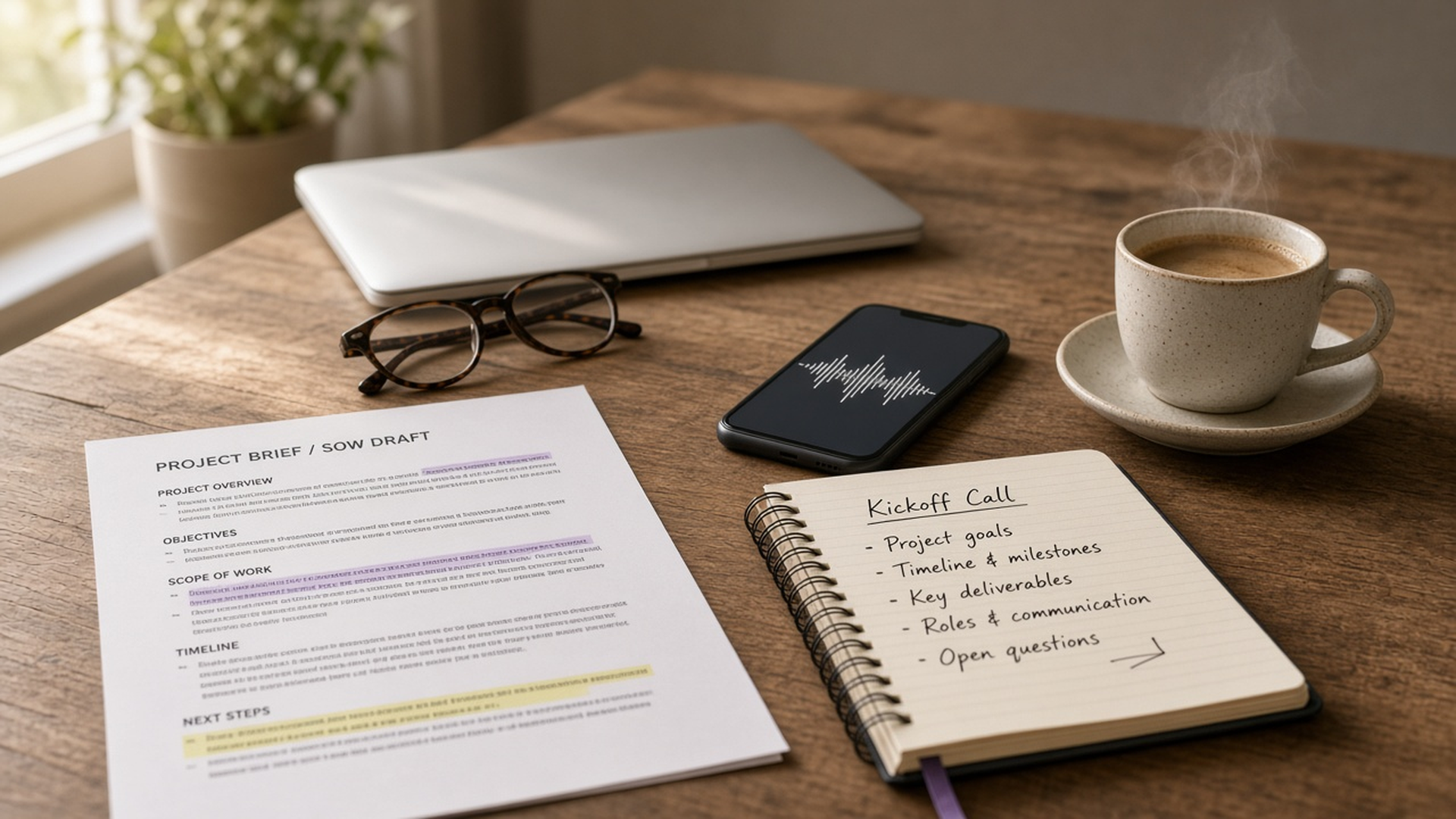
The kickoff went well. An hour on Zoom, slides shared, faces nodding, a cheerful "we're excited to partner." Someone typed a few bullets into Notion while the call was still running. Someone else promised to "send the brief by Friday."
Friday arrives. The brief has a polished overview, a vague timeline, and three open questions that were already answered on the call. The client's exact phrasing about what is out of scope is gone. The quiet "we can't do that until Q2" became "pending confirmation." The designer who joined late asks what success looks like. Nobody can quote the sentence. The recording sits in the calendar invite, sixty minutes long, and nobody is going to scrub it again just to find the line about the brand guidelines living in a shared drive nobody named.
Most of what a kickoff actually decides never becomes text the delivery team can use.
Why kickoff notes are thinner than the call
A kickoff is dense on purpose. In one sitting, a good client (or a good internal stakeholder) will mention:
- What "done" looks like. Not the slide title, but the messy sentence: "If legal can paste this into the packet without rewriting it, we're good."
- What is explicitly out. The features, formats, languages, or audiences they do not want, often said casually between two louder priorities.
- Assumptions they treat as facts. "We'll handle copy" or "IT already approved the stack" that later turn out to be hopes.
- People who were not on the call. Approvers, blockers, and the person who will "hate the color" if you do not loop them in.
- Constraints said once. Budget caps, blackout weeks, compliance rules, and "our CEO only reads one-pagers."
You cannot hold all of that while facilitating, sharing a screen, and keeping the energy up. So the notes become a polite skeleton of the conversation, written in your voice, not theirs. The brief inherits that skeleton. Then the project inherits the gaps.
Summaries are fine for status updates. They are a weak foundation for scope.
The recording is already the source of truth
If you recorded the kickoff, you already captured the real brief. The problem is the format. An hour of audio is a terrible project document. You cannot search it for "out of scope." You cannot paste a constraint into a ticket. You cannot skim it in five minutes before a sprint planning session.
A transcript changes the format without inventing new content. The same kickoff becomes a page you can:
- Search. Find every mention of deadline, owner, exclusion, brand, legal, or a person's name.
- Quote. Put the client's actual words into the brief, the SOW addendum, or a Slack clarification instead of paraphrasing from memory.
- Handoff. Give a designer, engineer, or freelancer who missed the call the transcript instead of a five-bullet recap and a shrug.
- Resolve disputes. When someone says "we never agreed to that," you can point to the line, not to a feeling from last Tuesday.
- Update the brief honestly. Fill the TBDs with what was already said, then mark only what is still open.
None of that requires a perfect project tool. It requires text.
What to pull into the brief
You do not need to paste the whole call into Confluence. You need a short, accurate extraction. After the kickoff, open the transcript and pull five things:
- Success in their words. Copy two or three sentences that define a good outcome. Keep the awkward specificity. "Something we can send to franchise owners without a training session" is more useful than "scalable enablement assets."
- In scope and out of scope. Every "we want," "we don't need," and "not this phase." Write exclusions as clearly as inclusions. Kickoffs often bury the outs in soft language.
- Assumptions and dependencies. Anything that starts with "assuming," "once IT," "after legal," or "when we get access." These are the landmines.
- Owners and absentees. Who decides, who reviews, who was missing, and who must see a draft before it goes wider.
- Dates that were spoken. Soft dates, hard dates, and "before the offsite" style anchors. Exact wording beats "sometime in March."
This takes fifteen to twenty minutes with a searchable transcript. It takes an afternoon of guesswork and follow-up emails without one.
Why the brief stays vague otherwise
Brief writing fails for a boring reason: the person who ran the kickoff already did the social work. Turning a lively call into a precise document feels like unpaid homework, so it gets rushed between other meetings. The polite summary wins. The sharp edges of the conversation get sanded off.
A transcript lowers the cost of doing it well. You are not reconstructing the call from memory while your calendar fills up. You are copying, lightly editing, and checking boxes. That difference matters when you have two kickoffs and a delivery crunch in the same week.
It also helps the client. Instead of sending a brief that reopens settled topics, you can send one that mirrors what they said. They recognize their own language. Approvals get faster because you are not asking them to re-explain themselves.
Who pays for a missing brief
The person who suffers most from a thin kickoff write-up is rarely the facilitator. It is everyone downstream:
- Designers who invent requirements the call already answered.
- Engineers who build the wrong edge case because "mobile" meant something specific and nobody wrote it down.
- Account managers who re-litigate scope in week three because the exclusions never made the page.
- New teammates who join mid-project and inherit folklore instead of a document.
- The client who has to repeat themselves on every status call because the first conversation evaporated into a recording.
A transcript is the cheapest way to make one good hour useful for the next six weeks.
A practical workflow that does not add theater
Keep it light. After the kickoff:
- Transcribe the recording the same day. Same-day beats "when I have time," which means never.
- Highlight, do not rewrite, first. Mark success criteria, outs, assumptions, owners, and dates in the transcript before you open the brief template.
- Paste quotes into the brief. Then write the polished summary around them. The quotes are the load-bearing walls.
- Send the brief with one ask. "Please confirm these five lines match what you said on the call." That is easier to approve than a ten-page reinterpretation.
- Link the transcript in the project space. Future you will need the sentence about the brand drive. Make it findable.
If your team already records Zoom, Meet, or Teams, you are not adding a new habit. You are finishing the one you started when you hit record.
Kickoffs are not unique. The pattern is
The same gap shows up in discovery calls that never reach the CRM, contractor walkthroughs that never become punch lists, and demos that never become FAQs. Spoken work creates decisions. Written work creates shared memory. When only the speaking happens, the project runs on optimism until the first disagreement.
Transcription is not about capturing every um. It is about keeping the sentences that would have saved an email thread, a redo, or a tense Friday sync.
Start with the call you already have
You do not need a new process document. Take the last kickoff recording still sitting in your calendar. Turn it into text. Spend twenty minutes filling the holes in the brief with what was already said. Notice how many "open questions" were not open at all.
That is the job: not more meetings, not longer notes written from memory, but a readable record of the meeting you already ran.
If the recording is on your phone or laptop, To The Text can turn it into a transcript you can search, quote, and paste into the brief before the next status call catches up with the gaps.