The Family Stories Nobody Wrote Down
Every family has a storyteller and a pile of stories that only exist in one person's memory. Record them, turn them into text, and give them a chance to outlast the dinner table.
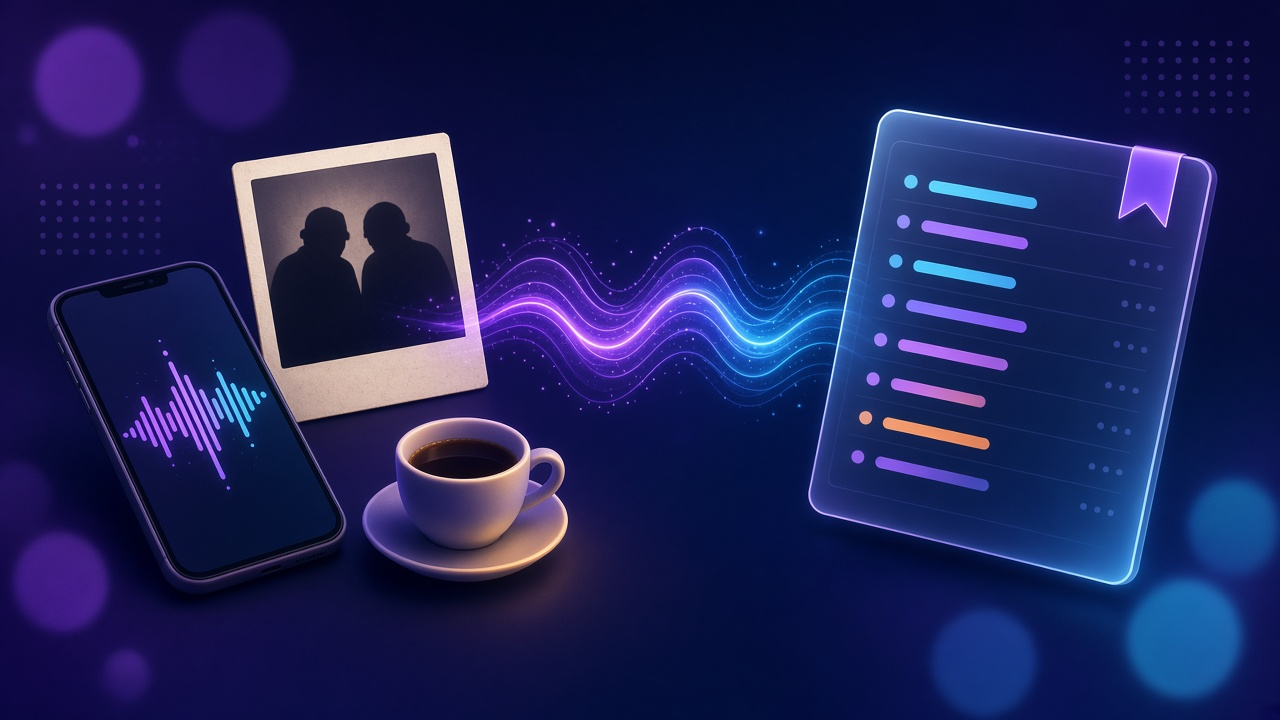
Every family has one. The person who, after the second cup of tea, starts with "Did I ever tell you about the time…"
And everyone half-listens, because they've heard it before. The train that left without him. The wedding where the cake fell. The neighbor who hid the radio. The village nobody can spell anymore.
Then one year, nobody is telling those stories. And you realize you only remember the punchlines.
Memory is a terrible archive
Family stories survive the way gossip does: retold, shortened, and slowly bent out of shape. Each retelling drops a name, a date, a detail that seemed boring at the time.
Three generations later, "Grandpa walked across the border in winter with a suitcase of books" becomes "someone in our family moved here once."
The person who knows the real version is usually still around. They're just not asked often enough, and when they are, nobody's taking notes.
Recording is the easy part
Most people already have the tool: a phone on the table. Press record, ask a question, and let them talk.
The trouble starts afterward. You end up with a file called New Recording 14.m4a, an hour and forty minutes long, sitting in a folder you'll never open. Nobody in the family is going to sit through it. Nobody can search it for "the name of that street." Nobody can forward the good part to a cousin overseas.
A recording keeps the story safe. A transcript makes it usable.
What a transcript gives the family
Once the conversation is on a page, a few things suddenly become possible:
- You can find things. Search for "1962," "the farm," or a great-aunt's name, and land on the exact moment she comes up.
- You can check the details. Names, places, and dates are written down, so you can look them up later or ask a follow-up question next visit.
- You can share pieces. Paste a paragraph into the family chat. Print a page for someone who doesn't listen to audio. Translate a section for relatives who speak another language.
- You can build on it. One transcript becomes notes for a family tree, captions under old photos, or a short printed booklet for a birthday.
The audio stays the treasure: the voice, the laugh, the pause before the sad part. The text is the index that lets people reach it.
How to have the conversation
You don't need a journalist's setup. You need a quiet table and good questions.
- Start with the stories they already love telling. Don't begin with "what was your childhood like." Begin with "tell me about the train again." Warm stories lead to unexpected ones.
- Ask for specifics, gently. "What street was that on?" "Who else was there?" "What did it smell like?" Those small details are exactly what memory loses first.
- Let silences sit. The pause after a question is often where the real answer is coming. Don't fill it.
- Keep sessions short. Thirty to forty-five minutes is plenty. Come back next week instead of wearing everyone out.
- Record everything, edit nothing during. Tangents are fine. Repeats are fine. You can tidy the text later.
Put the phone flat on the table, close to the speaker, away from the clinking cups. Background noise is the main thing that makes a transcript harder to read.
A simple way to keep it organized
A hypothetical example of how one family might set it up:
| Session | Who | Main stories | Follow-ups for next time |
|---|---|---|---|
| 1 | Grandma | Moving to the city, first job at the bakery | Name of the bakery owner? |
| 2 | Grandma + uncle | The flood year, rebuilding the house | Find photos from that summer |
| 3 | Grandpa | Army service, meeting Grandma at a dance | Which town was the dance in? |
Keep the audio and the transcript together, named by date and person. A shared folder works fine. The point is that someone in twenty years can open it and understand what they're looking at.
Don't clean it into a biography
When you edit the transcript, resist the urge to turn it into polished prose.
Keep the phrases they actually use. Keep the odd grammar, the dialect, the repeated "and so, and so." That's what makes it sound like them. Fix obvious transcription mistakes, add the correct spelling of names in brackets, and leave the voice alone.
A tidy biography is nice. A page where you can still hear your grandmother talking is better.
A recording keeps their voice. A transcript lets the family actually use it.
It's not only for grandparents
The same idea works for any story that lives in one person's head: a parent explaining how they started the family business, a sibling remembering a childhood you were too young for, an old friend telling the story of how your parents met.
You don't need a big project. You need one conversation, recorded, and turned into text before you forget you have it.
Soft close
Most family history isn't lost in a fire or a flood. It's lost in a quiet, ordinary way, because nobody wrote it down while the storyteller was still at the table.
Next visit, put your phone on the table and ask for the story about the train.
To The Text on iPhone can turn those recordings into readable, searchable text, so the stories don't stay buried in an audio file nobody opens.