The Discovery Call Never Made the CRM
Sales discovery calls are full of buying signals, objections, and exact wording that never reaches the CRM. Transcribing the recording turns a half-hour of talk into notes your whole team can search and reuse.
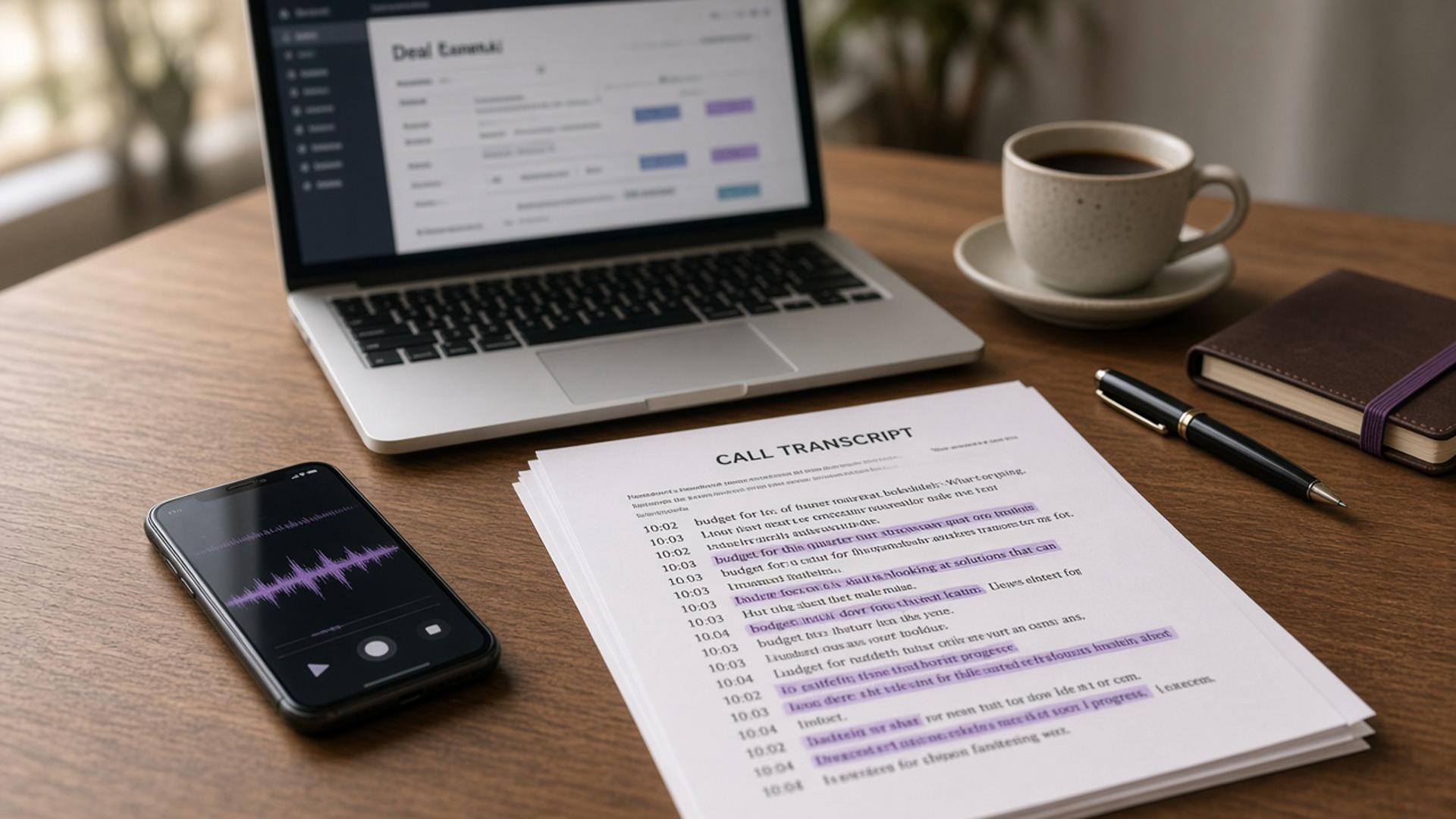
The call went well. Forty minutes, good rapport, a clear next step. You hang up, open the CRM, and type what you remember.
Budget: "flexible." Timeline: "Q1-ish." Pain: "something about reporting." Competitor: "they mentioned one, maybe two." Then you move on to the next call, because there are five more today.
Two weeks later, a teammate joins the opportunity and asks what the buyer actually cares about. You open the deal page. The notes are thin. The recording is somewhere in Zoom or Gong or your phone, forty minutes long, and nobody is going to listen to it again just to find the sentence about the quarterly board pack.
Most of what a buyer reveals on a discovery call never becomes text anyone else can use.
Why discovery notes are almost always wrong
A discovery call is dense. In half an hour, a good buyer will mention:
- What broke. The specific report, handoff, or tool that stopped working, often with a date or a name attached.
- Who else is involved. A CFO who cares about cost, a manager who cares about speed, an IT person who cares about security.
- What they already tried. Competitors, internal tools, a failed pilot, a consultant who left.
- How they talk about the problem. The exact phrases they use with their boss, which are almost never the phrases in your pitch deck.
- Soft nos and soft yeses. "We'd need legal to look at that" is different from "we'd never do that," and both get flattened into "objection: legal" in a CRM field.
You cannot hold all of that in working memory while also running the call. So the notes become a summary of a summary, written under time pressure, in your own words rather than theirs.
Summaries are useful for status. They are almost useless for quoting, coaching, or handing a deal to someone else.
The recording is already there
If your team records calls, you already have the raw material. The problem is the format. A forty-minute audio file is a terrible knowledge base. You cannot search it for "board pack." You cannot paste a sentence into a proposal. You cannot skim it in three minutes before a follow-up.
A transcript changes the format without changing the content. The same call becomes a document you can:
- Search. Find every mention of budget, timeline, competitor, or a person's name.
- Quote. Put the buyer's actual words into a proposal, a one-pager, or a Slack update to your AE.
- Handoff. Give a new teammate the transcript instead of a five-bullet summary and a shrug.
- Coach. Review what questions landed and which ones got vague answers, without rewatching the whole call.
- Compare. Read three discovery calls from the same segment side by side and see which pains keep showing up.
None of that requires a perfect CRM. It requires text.
What to pull out of the transcript
You do not need to paste the whole call into the deal. You need a short, accurate extraction. After the call, open the transcript and look for five things:
- The problem in their words. Copy two or three sentences that describe the pain. Do not rewrite them into marketing language yet. Keep the awkward, specific phrasing. That is what they will recognize later.
- Stakeholders and roles. Every name, title, and "they'll need to approve this." Put them in the CRM as people, not as a single "decision maker" field.
- Constraints. Budget ranges, procurement steps, security reviews, blackout dates, and anything that starts with "we can't" or "we'd have to."
- Buying language. Phrases they already use with their boss. If they said "we're drowning in spreadsheet reconciliations," that belongs in the proposal, not "streamline financial workflows."
- Next-step commitments. What they agreed to do, what you agreed to send, and by when. Exact wording beats "follow up next week."
This takes ten to fifteen minutes with a searchable transcript. It takes forever with a recording you scrub by ear.
Why the CRM stays empty otherwise
CRM hygiene fails for a boring reason: updating it after a good call feels like unpaid homework. The salesperson already did the hard part. Typing a careful summary into twelve fields is the least rewarding part of the job, so it gets rushed or skipped.
A transcript lowers the cost of doing it well. You are not inventing notes from memory. You are copying and lightly editing. That difference matters when you have six calls in a day.
It also helps managers. Instead of nagging people to "fill out the fields," you can ask for three pasted quotes and a next-step line. The deal page gets better because the work got easier, not because someone threatened a forecast review.
Beyond the AE who ran the call
The person who suffers most from missing discovery detail is rarely the person who ran the call. It is everyone downstream:
- Solutions engineers who join late and have to ask the same questions again.
- Customer success who inherits a closed-won deal with almost no record of what was promised.
- Marketing who never sees the raw language buyers use, so campaigns stay abstract.
- Product who hears filtered summaries instead of the sentence that would change a roadmap priority.
- The next AE who picks up the opportunity after a territory change and has to rebuild context from three vague fields.
A transcript is the cheapest way to make one good conversation useful to five other people.
A few practical rules
Get consent and follow the rules. Many teams already announce that calls are recorded. If yours does not, say it at the start. Recording and privacy laws differ by place, and buyer trust matters more than a perfect note.
Do not dump the raw transcript into the CRM as the only note. Raw text is long and hard to scan. Extract the five things above, then keep the full transcript linked or filed where the team can open it.
Protect sensitive bits. Discovery calls can include salaries, internal politics, or competitive details. Treat the transcript like any other customer data: limited access, no casual forwarding outside the deal team.
Check names and numbers. Automatic transcription is strong on ordinary speech and weaker on unusual product names, acronyms, and fast-spoken figures. Spot-check anything you plan to quote in a proposal.
Use it the same week. The value drops fast. Extract while the call is still warm, then the CRM update takes minutes instead of becoming archaeology.
The sentence that closes the deal
Somewhere in almost every good discovery call is one sentence the buyer will recognize as their own. It is usually not the polished one in your pitch. It is the slightly frustrated, specific thing they said about last quarter's mess.
If that sentence only lives in a recording, it might as well not exist. If it lives in a transcript, you can put it in the proposal, the demo script, and the kickoff brief for success.
When your discovery calls are already on your iPhone or in a call recording, To The Text can turn them into clean, searchable text you can extract from and keep with the deal. Then the CRM stops being a guess, and the next person on the opportunity can read what the buyer actually said.