The Correction You Heard Three Lessons Ago
Private lessons in music, singing, sport, or driving are packed with spoken corrections that fade before you practice. Recording the lesson (with your teacher's permission) and reading the transcript turns each session into a practice plan you can actually follow.
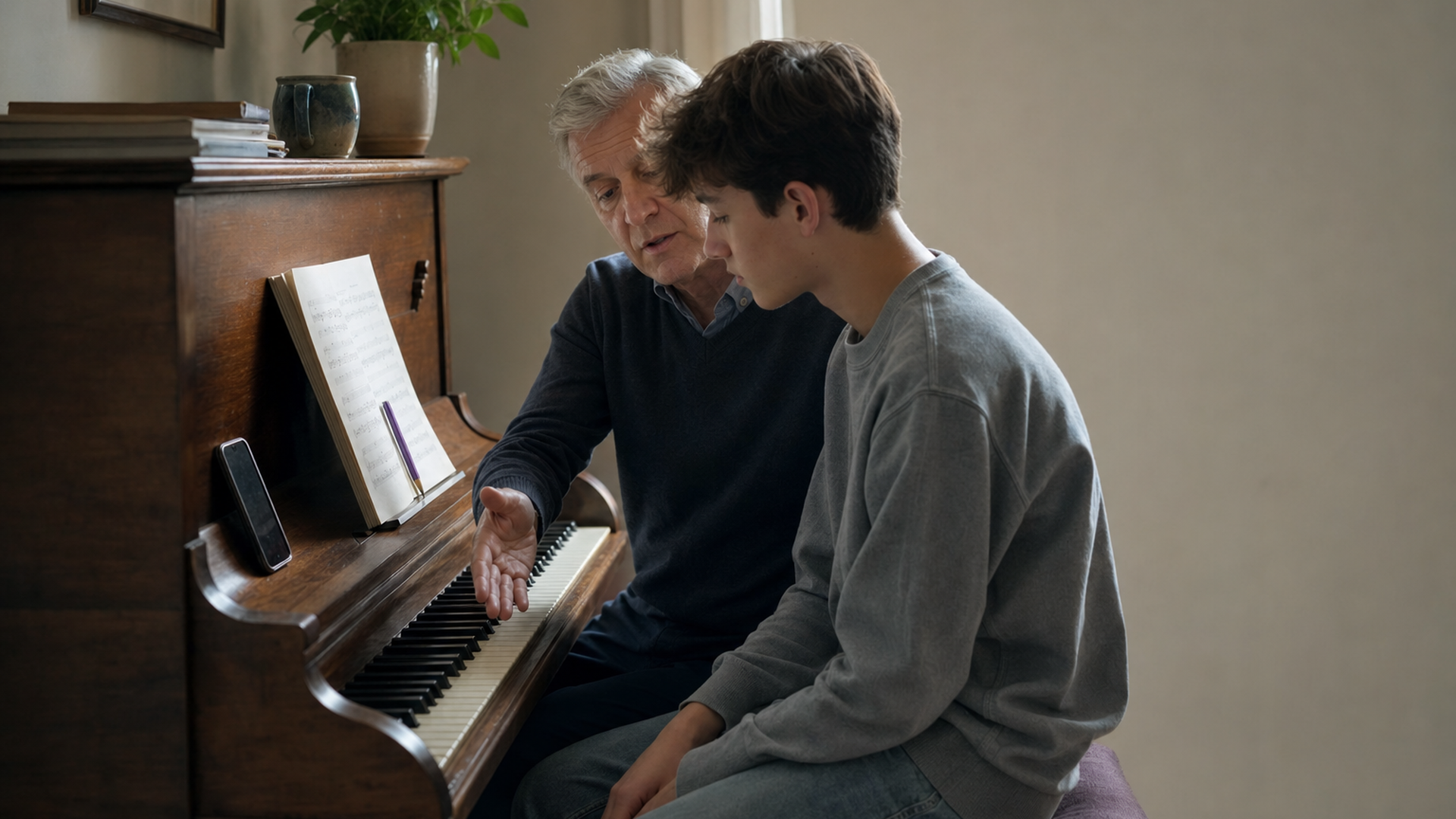
Halfway through your piano lesson, your teacher stops you. "Again from bar twelve," they say. "Your wrist is collapsing on the descent, so the thumb lands late. Keep the wrist level, think of the thumb as already on its way, and play it slower than you want to." You nod. You try it. It is better. The lesson moves on.
Three weeks later, at bar twelve, your teacher stops you again. "Your wrist is collapsing on the descent." Same words. Same fix. And somewhere in the back of your mind you realize that you have heard this before, that you agreed with it, and that you did not practice it once.
This is one of the most common and least discussed problems in learning anything one-on-one. A private lesson is dense with spoken corrections, and most of them evaporate before your first practice session.
Why lessons leak
A lesson with a good teacher is an unusually rich hour. In thirty or sixty minutes you might get a dozen specific corrections, two or three new exercises, an explanation of why something works, a story about how they solved the same problem, and a plan for the week. Almost all of it is spoken. Very little of it is written down.
And it arrives at the worst possible moment to remember it. While your teacher is talking, you are usually doing something with your hands, your voice, or your body. Your attention is split between listening and performing. You are often a little nervous. And the most important comments tend to come right after a mistake, when your mind is still busy replaying what went wrong.
Then the lesson ends, and you leave with a general impression. "Work on the scales. Something about the wrist. She liked the second piece." By the time you sit down to practice, the instructions have flattened into a mood.
This is not limited to piano. It happens in voice lessons, where the coach describes exactly where the breath should go. In tennis and golf, where the pro gives you three cues about your shoulder and one about your feet. In language tutoring, where the tutor quietly corrects the same verb ending every week. In driving lessons, where the instructor explains a junction you will face again on the test. Wherever learning happens through a teacher talking to you while you try, the same leak appears.
The notebook that never quite works
Many teachers suggest keeping a practice notebook, and some write in it for you. It helps, but it has limits.
A teacher's handwritten note is a summary of a summary. "Wrist level, bar 12" is useful as a reminder, but it leaves out the reasoning, the image they used, and the exercise they suggested to fix it. Your own notes, written after the lesson, are worse: you write down what you remember, which is exactly the part you were least likely to forget.
What gets lost is the texture. The analogy that made it click. The order in which to fix things. The warning, "don't try this faster until it is easy at this tempo," that turns out to be the whole point.
What a transcript gives you
If you record your lesson (always with your teacher's agreement) and turn the recording into text, the hour stops being a memory and becomes a document. That changes several things.
You can find the corrections. Instead of scrubbing through a forty-minute audio file looking for the moment your teacher mentioned breathing, you search the transcript for "breath" and read every instance. Corrections become a list instead of a vague cloud.
You can read them in your teacher's words. The exact phrasing matters. "Think of the thumb as already on its way" is a different instruction from "move your thumb faster," and the first one is the one that works. A transcript keeps the version your teacher chose.
You can turn a lesson into a practice plan. Read the transcript once, pull out every concrete instruction, and you have a checklist for the week: what to play, at what tempo, with what focus, and what to avoid. That is far more useful than "practice the Chopin."
You can see patterns over time. Keep a few weeks of transcripts and search them. If the same correction appears in three lessons, that is not a coincidence. It is the thing to fix first, and now you have proof of it.
You can bring better questions. Reading back a lesson, you notice the moments where you did not really understand and just nodded. Those become the first questions for next week, which is a better use of an expensive hour than hearing the same explanation again.
A simple routine that fits around lessons
You do not need a complicated system. A few habits are enough.
1. Ask once, then make it normal. Most teachers are happy for students to record, and many already recommend it. Ask at the start: "Would you mind if I record the lesson so I can review it when I practice?" If they prefer not, respect that and take notes instead.
2. Put your phone somewhere quiet and close. On the music stand, the side of the court, the passenger seat dashboard mount. You want your teacher's voice clear, not the rustle of your pocket.
3. Transcribe the same day. The best time to read a lesson is within a few hours, while you still remember what the corrections felt like. The transcript fills in the words, and your memory fills in the sensation.
4. Pull out the instructions. Skim the transcript and copy every specific instruction into a short list at the top: the correction, the reason, the exercise. Five to ten lines is plenty.
5. Practice from the list, not from the recording. Listening back to a full lesson before every practice session is slow and passive. A short written list you can glance at between attempts keeps you working, not rewatching.
6. Keep the archive. Store your transcripts in one folder or notes app. Before an exam, a recital, or a test drive, reread the last month. You will be surprised how much you had already been told.
What this is not
A transcript is not a replacement for listening during the lesson, and it is not a way to skip the hard part. Corrections still have to go into your hands, voice, or body through repetition. What the transcript does is make sure the repetition is aimed at the right thing.
It is also not about judging your teacher. Some of the best moments in a lesson are tangents, jokes, and half-finished thoughts, and those belong in the room. Keep your recordings and transcripts private, for your own practice, and delete them when they are no longer useful. If you want to share something with another student or a parent, ask your teacher first.
For teachers, too
Teachers can use the same approach from the other side. Recording your own teaching, with your student's consent, and reading the transcript afterwards shows you how you actually explain things. You might notice that you give six corrections at once when one would land better, or that one analogy works consistently and another never does. Some teachers send students a short written recap drawn from the transcript, which saves everyone from the "what did we do last week?" opening.
Stop paying for the same lesson twice
Private lessons are expensive, in money and in time. Every correction you hear twice is a correction you paid for twice. The fix is not to try harder to remember. It is to stop relying on memory for the part of the lesson that was only ever spoken.
If you want an easy way to do that, To The Text turns your recordings and videos into clean, searchable transcripts right on your iPhone. Record the lesson, transcribe it on the way home, and practice from what your teacher actually said. Download To The Text on the App Store before your next lesson.