The Contractor Said It on the Walkthrough
Renovation promises, repair estimates, and landlord walkthroughs are mostly spoken. Recording the walkthrough and turning it into a transcript gives you a clear record of scope, price, and timing before anyone starts work.
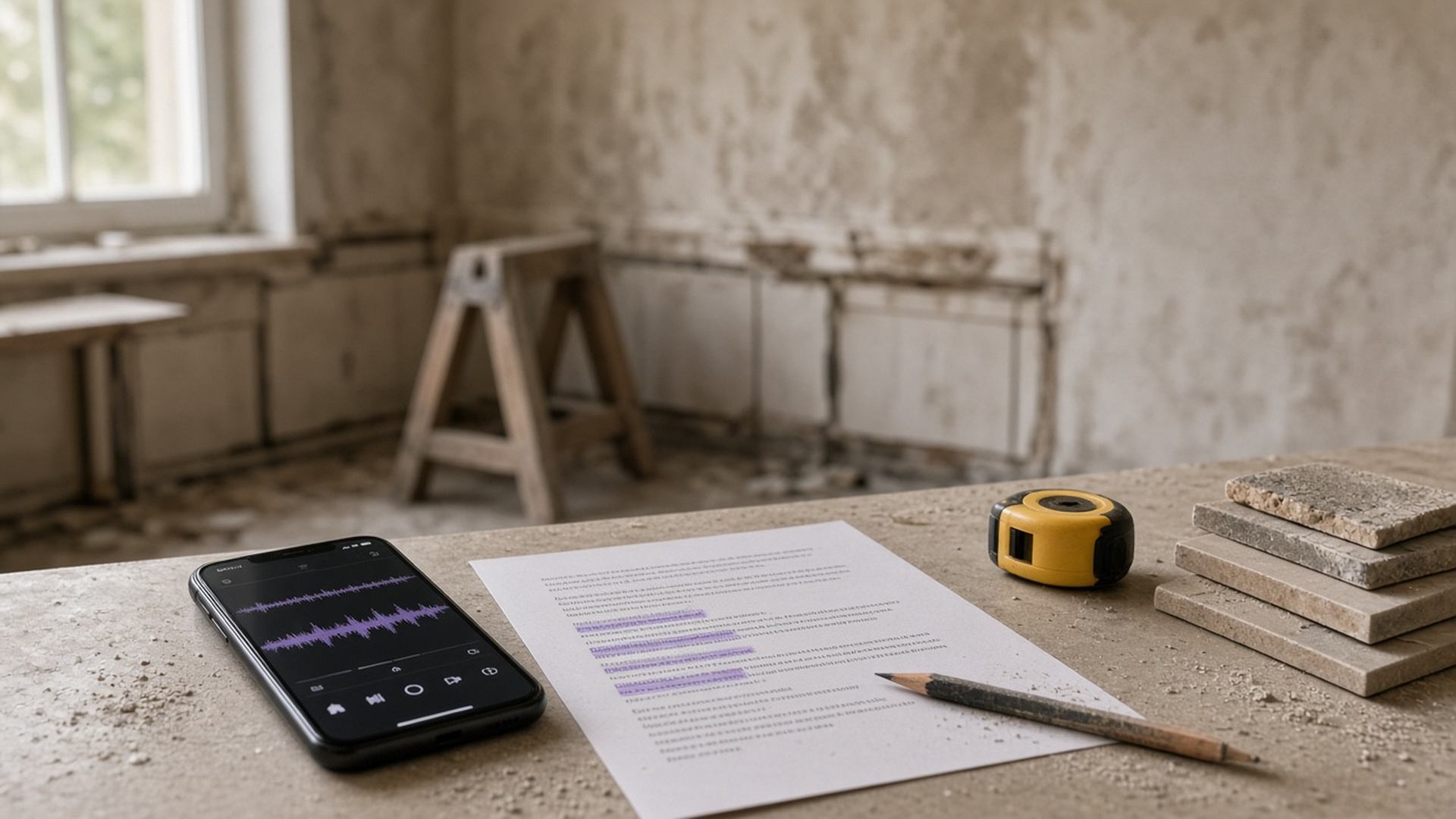
The most important part of a renovation usually happens in about twenty minutes, standing in a half-empty room.
The contractor walks through the kitchen, taps a wall, looks under the sink, and talks. "This cabinet comes out. We'll keep the plumbing where it is. The tile is included, but if you want the bigger format it's extra. Two weeks, maybe three if the inspector is slow." You nod. It all sounds clear.
Three weeks later, the written estimate arrives. It's shorter than the conversation. Some things are missing, some are vaguer, and one of them is now "subject to change." When you raise it, the reply is polite and firm: "I don't think I said that."
Nobody is necessarily lying. Both of you heard the same walkthrough and remember different versions of it. That's what memory does with a long, casual, spoken conversation full of numbers.
Most of what gets agreed in home projects is agreed out loud, and almost none of it is written down the way it was said.
Why walkthroughs are where details go missing
A walkthrough is a strange kind of meeting. It's informal, it moves from room to room, and it mixes small talk with decisions that cost real money. A few things make it especially easy to lose details:
- Numbers come fast. Prices, measurements, quantities, and dates are mentioned in passing, often several in one sentence.
- Conditions get buried. "Included, unless the subfloor is rotten" is two facts. People tend to remember the first half.
- Options blur together. When you discuss three tile choices and two layouts, the price you remember may belong to the option you didn't pick.
- Nobody is taking notes. Your hands are full, you're looking at the wall, and writing while someone talks feels a little rude.
Then the written estimate is produced later, from the contractor's memory and notes, not from the conversation itself. It's a summary, and summaries leave things out.
The recording is the easy part
Most people already have a way to fix this in their pocket. A phone can record the whole walkthrough without anyone holding a notebook. Some people film it, which is even better: you get the room, the wall they tapped, and the cabinet they pointed at, along with their words.
The problem is what happens next. A thirty-minute walkthrough video is not something you'll rewatch to find the sentence about the subfloor. It sits in your camera roll next to photos of paint samples, and by the time there's a disagreement, you're scrubbing through footage on a phone trying to find a ten-second clip.
A transcript turns that footage into something you can actually use. You can search it for "tile," "included," or "weeks." You can copy the exact sentence into an email. You can read the whole thing in four minutes instead of rewatching it in thirty.
What to look for in the transcript
Once you have the walkthrough as text, read it with a pen, or a highlighter if you print it. You're looking for a few specific things:
- Scope. Every item they said they would do, remove, replace, or keep. Make a plain list.
- Prices and what they include. Note each number and the words around it. "Labor and materials" is very different from "labor."
- Conditions and exceptions. Look for "unless," "if," "depends," "probably," and "should be." These are where surprises live.
- Timing. Start dates, durations, and anything they said about delays, permits, or other jobs they're finishing.
- Your own requests. It's easy to forget what you asked for. The transcript remembers that too.
Then put the written estimate next to that list. Anything in the conversation that's missing from the estimate is a question to ask now, while it's still cheap to ask.
Turning it into a better estimate
The goal is not to catch anyone out. Most contractors are busy, not dishonest, and a clear follow-up actually helps them. A good way to use the transcript is a short, friendly email:
Thanks for coming by on Tuesday. Before we sign, I want to make sure I understood everything. On the walkthrough you mentioned the old cabinets would be removed and disposed of, and that the tile price included the backsplash. I don't see either in the estimate. Could you confirm or update it?
That email takes five minutes to write when you have the transcript in front of you. Without it, you'd be writing from memory, which is exactly the problem you were trying to avoid.
When they reply in writing, the spoken agreement becomes a written one. That's the whole point.
Not just for renovations
The same pattern shows up anywhere a spoken conversation ends with a price and a promise:
- Apartment viewings and move-in inspections. What the landlord said would be fixed before you move in, and which marks on the floor were already there.
- Car repairs. The mechanic's explanation of what's urgent, what can wait, and what the estimate covers.
- Moving companies. What's included in the quote, how fragile items are handled, and what counts as extra.
- Event venues and caterers. Headcounts, setup times, and what "basic package" actually means.
- Home inspections before buying. Inspectors often say far more on the walk than ends up in the written report, including the things they'd personally fix first.
In each case, the person explaining knows much more than they'll write down later. The walkthrough is when that knowledge is shared, and it's shared out loud.
A few things to keep in mind
Ask before you record. Say it plainly: "Do you mind if I record this so I don't forget anything?" Most professionals are fine with it, and many appreciate that you're taking the details seriously. Recording laws also differ between places, and in some of them everyone in the conversation has to agree. Asking keeps things simple and honest.
A transcript is not a contract. It's a record of what was said, which is extremely useful for asking good questions and resolving confusion. The agreement that actually protects you is the written one you both sign. Use the transcript to make that document complete.
Check numbers against the audio. Transcription is very good with ordinary speech, but a noisy room with a running drill can blur "fifteen" and "fifty." For any number that matters, jump back to that moment in the recording and confirm it.
Keep it with the project. Save the transcript in the same folder as the estimate, the invoices, and the photos. If something comes up six months later, it will take seconds to find.
The sentence you'll need later
Every project has one sentence that ends up mattering. It's usually said casually, halfway through the walkthrough, while someone is looking at a pipe. You won't know which sentence it is until later, which is why it helps to keep all of them.
If you record walkthroughs on your iPhone, To The Text can turn the audio or video into clean, searchable text you can export and keep with your project files. Then, when someone says "I don't think I said that," you can simply look.