The Best Answers Were in the Q&A
Talks, panels, webinars, and all-hands meetings save their most useful material for the unscripted questions at the end. Transcribing the Q&A turns those answers into something you can actually reuse.
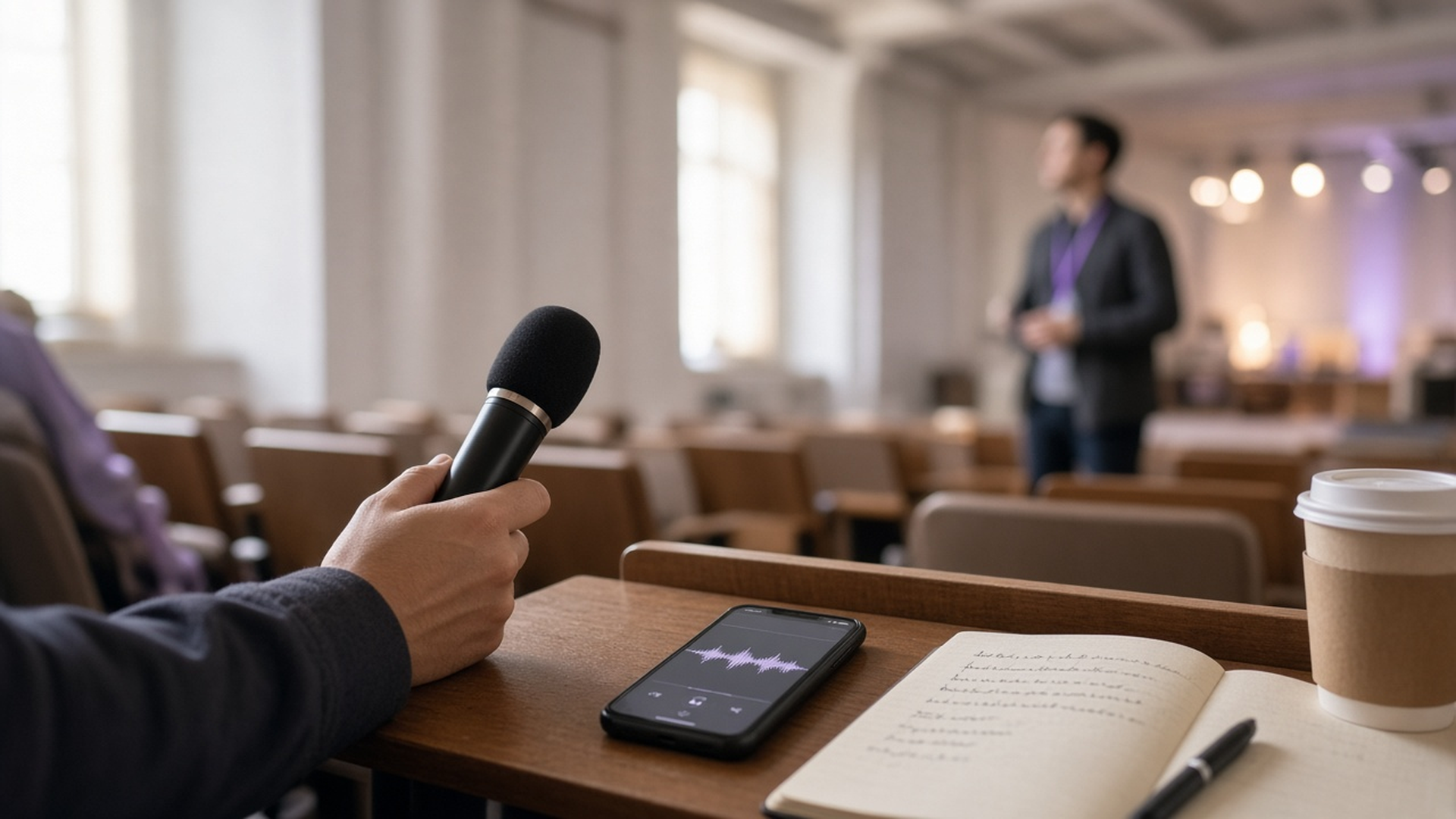
The talk itself was fine. Forty minutes of well-rehearsed slides, a few charts, a story the speaker has clearly told twenty times before. People clapped politely. Then the moderator said, "We have a few minutes for questions," and the room woke up.
Someone asked what happened to the project that failed. Someone else asked what they would do with half the budget. A quiet person near the back asked the question everyone was thinking, and the speaker paused, laughed, and gave an answer that was more honest and more useful than anything on the slides.
A week later, the organizers send around the deck. The deck has none of that. The recording exists somewhere, but the Q&A starts at minute 41 of a 58-minute file, and nobody is going to scrub through it to find the one sentence about why the pilot was cancelled.
The most valuable part of many talks is the part that was never written down in the first place.
Why the Q&A is different from the talk
A prepared talk is a finished product. The speaker has already decided what to say, cut what sounds risky, and smoothed every claim into something safe to put on a slide. You could read it in a blog post and lose very little.
The Q&A is the opposite. It is unscripted by definition, and that changes what comes out:
- Real constraints show up. "Honestly, we only did it that way because legal wouldn't sign off on the other version."
- Numbers that weren't on slides get said out loud. Team sizes, timelines, costs, failure rates, the stuff that makes a case study believable.
- Speakers disagree with themselves. The slide says "always," the answer says "well, in most cases, unless..."
- The audience names the gaps. Good questions point straight at what the talk avoided, and the answers fill it in.
- Panelists stop agreeing. On a panel, the moderated portion is often polite consensus. The audience questions are where the panelists actually push back on each other.
That material is exactly what you would want to quote in a report, share with your team, or use to make a decision. It is also the material most likely to disappear, because it lives only in audio.
Why nobody goes back for it
Everyone means to revisit the recording. Very few people do, and the reasons are boring and predictable.
Recordings are long, and the Q&A is buried at the end. Video players are bad at finding specific moments; you drag a scrubber, land in the middle of a sentence, drag again. Audience microphones are often weak, so the question itself is half-inaudible, and without the question the answer makes less sense. And by the time you think of going back, you have forgotten which talk the good answer was in, let alone the minute.
So the useful parts survive only as memory, and memory is generous to itself. You remember the gist and a confident paraphrase. You do not remember the caveat, the exact number, or who actually said it on a four-person panel.
What changes when the Q&A becomes text
Turn the recording into a transcript and the Q&A stops being a buried section of a video file. It becomes a list of questions and answers you can read in five minutes.
A few things become easy that were practically impossible before:
You can skim the questions first. Reading just the questions tells you in thirty seconds whether the session is worth your time. Most audiences ask better questions than the session title promised.
You can search across sessions. If you attended a conference or a webinar series, the same theme often comes up in several Q&As. With transcripts, a search for "pricing" or "migration" or "hiring" pulls every answer together, regardless of which room it happened in.
You can quote accurately. When you write up the event for your team, you can paste the actual sentence instead of reconstructing it. That matters most when the answer was surprising, because surprising claims are the ones people will challenge.
You can attribute correctly. On a panel, a transcript with speaker changes makes it clear which person said what. Paraphrasing from memory tends to assign the best line to the most famous panelist.
You recover the inaudible question. Even when the audience mic was weak, transcription often catches more than your ear did, and the answer usually restates enough of the question to fill in the rest.
Where this pays off
This is not just about conferences. The same pattern, a scripted part followed by an unscripted part that matters more, shows up all over the place.
Company all-hands meetings. The presentation is the approved message. The questions from employees are where leadership explains what it really means for teams, budgets, and timelines. People who missed the meeting deserve the answers, not just the slides.
Webinars and product demos. The demo shows the happy path. The questions reveal the limitations, the workarounds, and the roadmap hints. If you are evaluating a tool, the Q&A transcript is often more informative than the sales deck.
University lectures and guest talks. Students often ask the clarifying question half the room needed. That answer is the bit worth adding to notes, and it is the bit most people miss while packing up.
Investor and community updates. Prepared remarks are carefully worded. Questions from the floor are where specifics slip out.
Book talks and author events. The reading is in the book. The answers about how it was written, what got cut, and what the author would change are not.
A simple way to keep the Q&A
You do not need an elaborate workflow. A few habits are enough:
- Record the whole session, not just the talk. If you are recording on your phone, keep going after the applause. The most useful ten minutes start there.
- Transcribe the full recording. Trying to trim it first means scrubbing again. Let the transcript do the finding.
- Pull out the questions as a list. Copy each question and the first sentence of its answer into a short document. That alone is a great event summary.
- Mark the answers that changed your mind. Highlight anything that contradicts the talk, adds a number, or names a real constraint.
- Share the text, not the video link. Colleagues will read a page of questions and answers. They will not watch a 58-minute recording to find minute 41.
If you organize events, consider publishing the Q&A transcript alongside the slides. It is a small amount of work, it makes the session more accessible to people who could not attend or who prefer reading, and it is usually the content attendees ask about afterwards.
Respect the room
One caution. Audience questions sometimes come from people who did not expect to be quoted, and speakers occasionally say things off the cuff they would phrase differently in print. Before you publish a transcript outside your team, check the event's recording policy, and leave out names of audience members unless they agreed to be identified. For internal notes and personal reference, the transcript is simply a better memory.
The answers are already recorded
Think about the last talk, webinar, or all-hands you attended where the questions were better than the presentation. Chances are a recording exists, and chances are nobody has gone back to it.
Turn it into text. Read just the questions. You will probably find at least one answer worth keeping that you had already half-forgotten.
If the recording is on your iPhone, To The Text can turn it into a transcript you can search, quote, and share, so the best part of the session doesn't stay buried at the end of a long video.