Six Apartments Later, They All Blur Together
Apartment and house viewings are fast, noisy, and full of spoken promises from agents and landlords. Recording your walkthroughs and turning them into transcripts lets you compare places on facts instead of a vague feeling, and keep a record of what you were told.
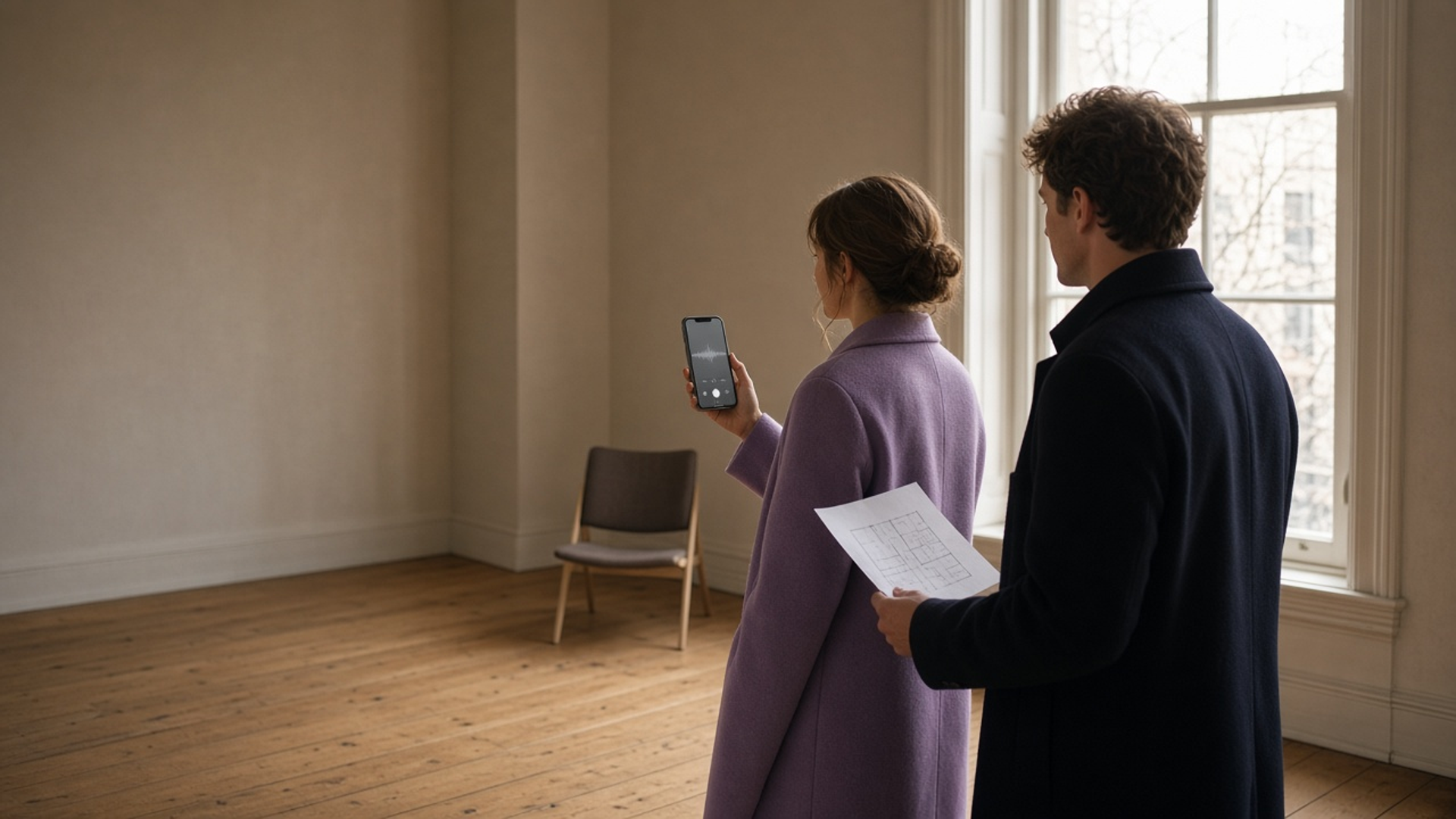
You saw six apartments on Saturday. The first one had beautiful light and a strange smell in the hallway. The second was cheap but far from everything. The third, or maybe the fourth, had the agent who said the building was "about to" renovate the elevator. One of them included heating in the rent. One of them did not allow a washing machine. One of them had a landlord who said he would "definitely be flexible" on the move-in date.
By Sunday evening, you and your partner are sitting at the kitchen table trying to decide, and you cannot agree on which apartment had the balcony.
This is not a failure of attention. It is what happens when you try to hold a dozen fast, spoken conversations in your head and compare them a day later. A viewing is mostly talk, and talk does not survive the walk back to the car.
Why viewings are so hard to remember
House hunting combines almost every condition that makes memory unreliable.
Everything happens back to back. In a competitive rental market, viewings are stacked in fifteen-minute slots, sometimes across different neighborhoods. You have no time between them to write anything down, and each new place overwrites the last.
The important information is spoken, not written. The listing tells you square meters and price. The viewing tells you everything else: what the utilities usually cost, how noisy the street is at night, whether the deposit is one month or three, whether the previous tenant left because of mold or because they had a baby. Almost none of that is in the listing, and agents rarely put it in an email unless you ask.
You are distracted by the rooms. You are opening cupboards, checking water pressure, looking out the window, imagining where the sofa goes. That is exactly what you should be doing. But it means you are half-listening when the landlord mentions, in passing, that the building has a rule against subletting.
Promises are casual. "We can probably repaint before you move in." "The internet here is very fast." "Pets shouldn't be a problem." These sentences feel reassuring in the moment and become impossible to pin down later. Did he say probably? Did she say shouldn't, or won't?
What a recording actually gives you
The simple fix is to record the viewing, with permission, and read the transcript afterward. Most agents and landlords are fine with it if you ask plainly: "Do you mind if I record this so I can remember the details? We're seeing a few places today." Some will say no, and that is their right. Many will shrug and keep talking. (Rules on recording conversations differ by country and region, so check what applies where you live, and always ask before you start.)
What you get is not a video tour. You probably took photos already. What you get is the conversation, the part your memory dropped.
A transcript turns the viewing into something you can compare. Instead of six blurry impressions, you have six documents. You can read them side by side and pull out the same facts from each: rent, deposit, utilities, contract length, move-in date, rules about pets or guests, what is furnished, what needs fixing. That is the information you will actually decide on, and now it sits in front of you in plain text.
It settles the arguments. Couples and flatmates often disagree about a place because they heard different parts of the conversation. One of you was in the bathroom when the agent explained the heating. With a transcript, you are no longer debating memories. You search for "heating" and read what was said.
It catches the things you did not notice. Reading a viewing back is surprisingly revealing. You see where the agent changed the subject when you asked about the neighbors. You see that the landlord answered "how much are utilities" with "it depends" three times. You see the throwaway line about the building's management company that you would never have remembered. Hesitations and vague answers are much easier to spot on the page than in a hallway.
It gives you a record of what you were told. If a landlord says the place will be repainted, or that the broken window will be fixed before you move in, that promise is only as good as your ability to remember and point to it. A transcript is not a contract, and you should still get important commitments in writing. But it tells you exactly what to ask for. "On Saturday you mentioned repainting the bedroom before move-in; can we add that to the lease?" is a much stronger email than "I think you said something about painting?"
A simple viewing workflow
You do not need a complicated system. A few habits are enough.
1. Record each viewing as a separate file. Start a new recording at the door and stop it when you leave. Name it with the address or the neighborhood right away, before the next viewing begins. "Elm street 2nd floor" is enough.
2. Say the key facts out loud. If the agent does not mention something important, ask on the recording. "So the rent is 900 and the deposit is two months, correct?" Now the answer is in the transcript, in their words. It also helps to narrate a few observations yourself as you walk: "Bedroom faces the courtyard, quiet. Small water stain on the ceiling near the window."
3. Transcribe the same evening. The longer you wait, the more the files themselves blur together. Turn each recording into text while you still remember which place had the green door.
4. Pull out a comparison table. Go through each transcript and copy the same handful of facts into a note or spreadsheet: price, deposit, extra costs, contract terms, condition, red flags, promises made. This takes ten minutes and replaces an hour of "wait, which one was that?"
5. Highlight the vague answers. Anything that sounded like "probably," "usually," or "we'll see" deserves a follow-up question before you sign. The transcript makes those easy to find.
6. Use the transcript in your follow-up email. When you contact the agent to apply or negotiate, quote the specific things they told you. It shows you were paying attention and makes it harder for a casual promise to quietly disappear.
It works for more than rentals
The same approach helps whenever you are comparing places or services through a series of spoken tours. Buying a home, where the stakes are higher and you might see the same property twice. Visiting daycares or schools, where staff explain routines and policies quickly. Touring wedding venues, coworking spaces, or care homes for a parent. In every case, the decision depends on details that were said once, out loud, while you were looking at something else.
A note on respect and privacy
Recording a viewing should feel transparent, not sneaky. Ask first, every time. If someone declines, put the phone away and take written notes instead. Keep the recordings and transcripts for yourself and whoever you are deciding with, and delete them once you have signed somewhere and no longer need them. The point is to remember what you were told, not to build a file on anyone.
Decide on facts, not on the last place you saw
There is a well-known pattern in house hunting: people often fall for the most recent viewing, or the one with the nicest light, and only later discover what they missed in the conversation. A transcript does not make the decision for you, but it puts every place on equal footing. The third apartment of the day gets the same clear record as the last one, and you can compare them calmly, at your own table, with all the details in front of you.
If you want an easy way to do this, To The Text turns your recordings and videos into clean, searchable transcripts right on your iPhone. Record the walkthrough, transcribe it that evening, and read back what everyone actually said. Download To The Text on the App Store before your next round of viewings.