Rewatching Is Not Reviewing
Playing a recording again feels productive. It usually isn't. Here's why listening back is a poor substitute for reading a transcript — and what to do instead.
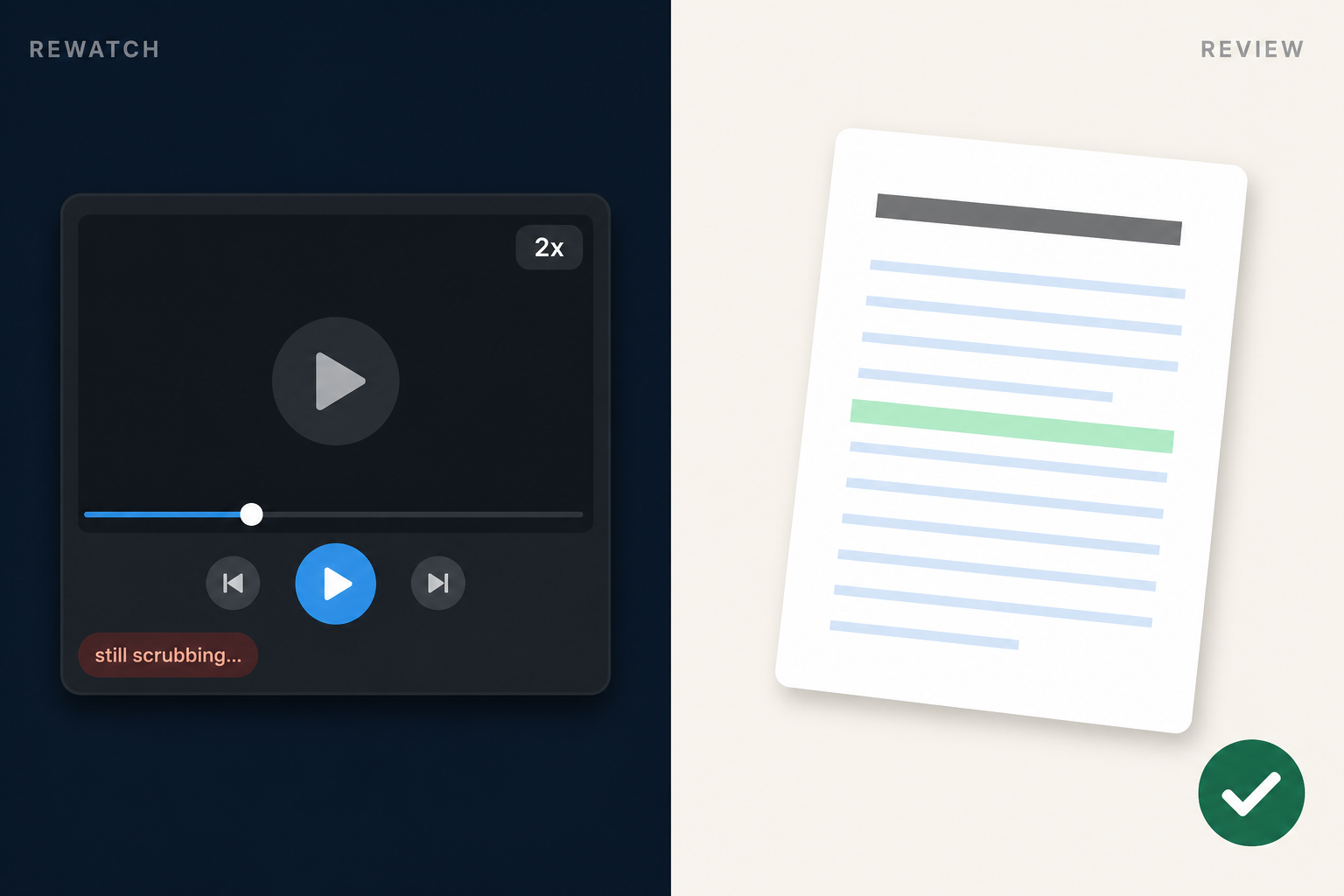
You finished the meeting. Or the lecture. Or the interview. The file is saved. Later you need one detail — a number, a name, a decision — so you open the recording and scrub.
Ten minutes later you are still listening. You told yourself this was review. It was not. It was rewatching.
Those are different jobs. Confusing them is how afternoons disappear inside a media player.
Playback is a poor thinking interface
A recording asks you to think at the speed of speech. Even at 1.5× or 2×, you are still locked to a timeline. You cannot jump to a heading. You cannot highlight a sentence. You cannot paste a quote into a brief without pausing, rewinding, and typing by ear.
Reading works the other way. Your eyes move faster than mouths. You skim past the throat-clearing and land on the claim. You re-read one paragraph without replaying three minutes of small talk.
That is the boring productivity math people skip: listening time scales with duration; reading time scales with density. A forty-minute call might contain six useful minutes. Rewatching still costs most of forty. A transcript lets you spend six.
Why "I'll just hit play again" feels responsible
Rewatching feels like diligence. You are not guessing. You are "going back to the source." The player is open. Headphones are on. It looks like work.
What it usually is:
- Searching for a sound instead of a phrase
- Re-absorbing filler because you cannot skip what you have not yet recognized
- Rebuilding context every time you pause and come back later
- Mistaking familiarity ("I've heard this before") for comprehension ("I can use this")
Familiarity is cheap. Usable recall is expensive. A second listen often buys the first without leaving behind an artifact anyone else can use.
Review has a different output
Real review produces something you can act on: a note, a quote, a decision list, a draft, a follow-up email. The recording is the source. The document is the working copy.
A useful review session answers questions like:
- What did we commit to?
- What exact words did the customer use?
- Which example from the lecture belongs in the study set?
- What line from the interview belongs in the article?
None of those answers live comfortably inside a scrubber. They live in text you can search, cite, and send.
If you walk away from a recording with only the feeling that you "went back through it," you reviewed the vibe. You did not review the content.
Where rewatching still wins
There are moments when you should watch again:
- Tone, hesitation, and pacing matter (negotiations, performances, coaching)
- Visual demos or slides are the point, not the speech
- You are checking whether a clip is usable as video, not mining it for words
Even then, a transcript helps you find the moment before you rewatch it. Search the text, then open the player at the right place. That is rewatching with a map. Scrubbing blind is rewatching as a maze.
A better habit than "save and hope"
Treat important recordings like unfinished notes until they become documents.
- Capture the video or audio while it is still fresh.
- Transcribe the same day — while you still remember who said what.
- Skim the text for decisions, quotes, and names.
- File the document next to the work it supports (project notes, study folder, interview draft).
- Rewatch only the segments the transcript proved worth seeing again.
That sequence turns a camera-roll pile into a library you can actually use. Leaving everything as media turns it into storage with guilt attached.
What this looks like on a phone
You do not need a desktop studio. On iPhone, pull the recording into To The Text, get a readable transcript, then export TXT or DOCX into whatever you already write in. Live voice mode covers the moments that never become a file at all — the hallway clarification, the idea you dictate while walking.
The goal is not more recordings. The goal is fewer hours spent pretending that playback is study.
Bottom line
Rewatching keeps the words trapped in time. Review pulls them into a page you can finish.
If the detail matters enough to hunt for, it matters enough to read. Make the transcript once; stop paying the rewatch tax every time you need a sentence.