Listening Later Is a Lie
We save recordings with the best intentions and almost never open them again. A transcript is the only format that gets reviewed — because text is the only format people actually skim.
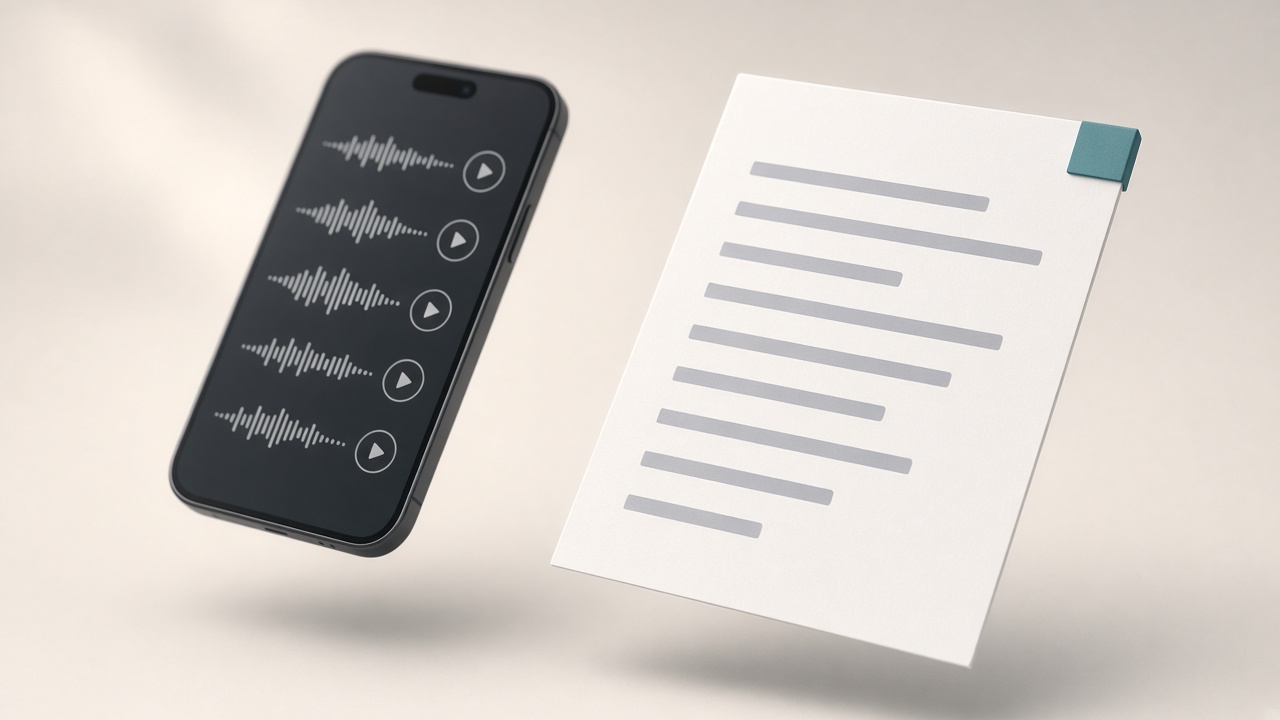
You hit record. You feel responsible. You close the call with a quiet promise: I'll listen later.
You will not.
The file will join a graveyard of Voice Memos, Zoom downloads, and lecture captures that felt important at the moment of capture and became invisible the moment they were safe.
The honesty problem
"Listening later" sounds like discipline. It is usually a deferral costume.
At the end of a dense hour you are tired, slightly behind, and already late for the next thing. Playback is the one task that can wait without anyone noticing — until you need a quote, a decision, or a number that lived only in that room.
By then the recording is still there. Your willingness to sit through it is not.
Why recordings almost never get opened
A recording is honest about length. An hour of speech costs an hour to hear at 1×, and still costs a painful stretch at 2×. Text does not.
People skip recordings because:
- The cost is front-loaded. You must commit before you know which three minutes matter.
- Search is blind. You cannot Cmd+F a waveform.
- Context decays. A week later you no longer remember why you saved it, only that it felt urgent.
- Guilt stacks. Unopened files become a shame pile, which makes opening any of them harder.
So the archive grows. The review rate does not.
What "I'll listen later" actually optimizes for
Recording without a path to text optimizes for feeling covered, not for being able to use what was said.
It protects you from the fear of missing something in the moment. It does almost nothing for the future version of you who needs a sentence, a commitment, or a name.
That future person does not want a media player. They want a page they can skim, highlight, paste, and file next to the work.
The asymmetry that changes behavior
Spoken audio is linear. Written language is random-access.
That single difference decides whether a capture becomes knowledge or clutter:
- Linear media rewards people with empty calendars and high willpower.
- Text rewards people with five spare minutes and a search box.
Most professionals live in the second group. Their tools should too.
A better promise than "later"
After anything worth keeping — a client call, a lecture, an interview, a long voice note — change the close:
- Capture the audio or video (you already do this).
- Turn it into text while the topic is still warm.
- Skim once, mark the decisions and quotes, then move on.
- Keep the transcript where the work lives. Keep the recording only if you still need tone or proof.
You do not need to re-listen to own the content. You need words you can open on a train.
Soft close
If your phone is full of recordings you meant to review, the problem is not laziness. It is format. Listening later was never a realistic plan for most of the conversations you care about.
To The Text turns those files on your iPhone into clean, editable text — so the knowledge you captured can actually get used, not just stored.