The Follow-Up Email Is Just a Bad Transcript
After a call, someone rewrites the conversation from memory into an email. That is slower and less accurate than starting from a transcript — and it quietly becomes the team's source of truth.
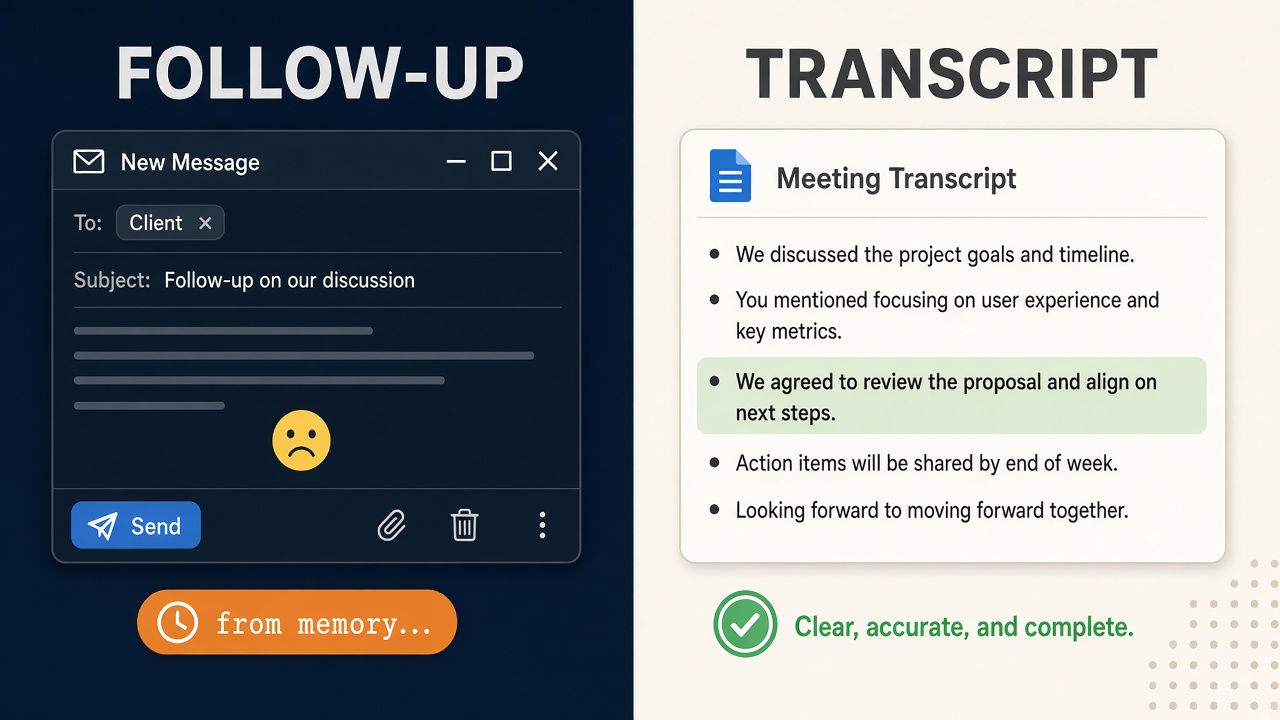
The meeting ends. Someone says the sacred line: "I'll send a follow-up."
An hour later, a carefully worded email arrives. Action items. "As discussed." A polite summary of what everyone thinks was said.
That email is doing the job of a transcript — badly.
What a follow-up email actually is
A follow-up email is a reconstruction. One person sits down, opens a blank message, and rebuilds the conversation from memory, notes scribbled mid-call, and whatever still feels important.
That process has a quiet tax:
- Details that felt obvious in the room evaporate
- Soft commitments harden into "we agreed"
- Soft disagreements disappear because they are awkward to write
- The person who writes the email becomes the unofficial historian
None of this is malicious. Memory is lossy. Writing from memory is editing with the lights off.
A transcript is different. It is not a retelling. It is the conversation you already had, sitting still long enough to quote.
Why "I'll summarize" feels responsible
Sending a follow-up feels like leadership. You are closing the loop. You are making the meeting "count."
What you are often doing:
- Replacing speech with a shorter, friendlier version of speech
- Choosing which threads survive
- Creating a document nobody can check against the source without scrubbing a recording
If there is a recording, people rarely open it. If there is no recording, the email is the record. Either way, the team inherits one person's compression of a multi-person hour.
Compression is useful. Silent compression is how misunderstandings get a calendar invite for next week.
The rewrite tax
Every follow-up email pays the same bill twice.
First you spent the meeting time. Then someone spends more time translating that meeting into prose. Then everyone spends time reading the translation and silently comparing it to their own memory.
A transcript flips the order. The words already exist. You skim, highlight, and paste. The "summary" becomes a short note on top of evidence, not a substitute for it.
That is the productivity math people skip: rewriting from memory costs attention; editing from text costs much less.
What changes when the transcript comes first
When the transcript is available right after the call:
- Action items can be copied from the moment they were spoken
- Disagreements stay visible instead of getting smoothed in the email voice
- People who missed the call can catch up without asking for a second briefing
- The follow-up email shrinks into what it should be: a pointer, not a novel
You can still send a short note. You should. Just stop pretending the note is the source of truth.
A better default
After a recorded call or interview, make text the first artifact — then write the human layer on top.
On iPhone, that can be as simple as opening To The Text, picking the recording, and exporting a clean transcript you can skim before anyone drafts the "as discussed" email.
The follow-up still matters. Tone matters. Priorities matter. What should not matter is whether the team's shared memory depends on who typed fastest after the call.
Keep the courtesy. Drop the reconstruction.