Fluent on Paper, Lost in the Call
Plenty of people read English far better than they hear it at full speed. A transcript turns a fast meeting, lecture, or interview in your second language into something you can actually follow, look up, and learn from.
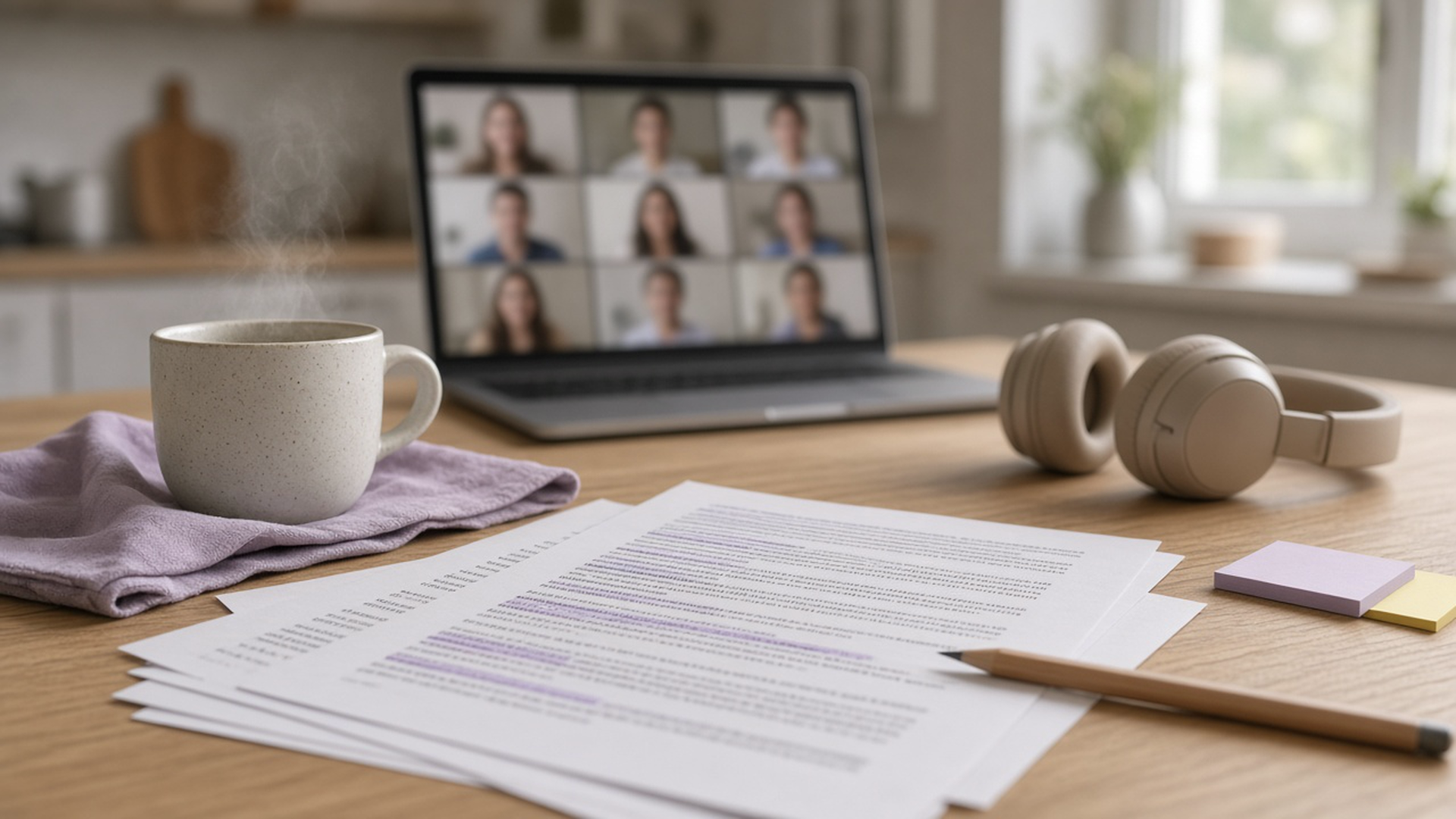
You read the project brief without a single pause. You wrote three careful emails before lunch. Your English is good, and you know it is good.
Then the call starts. Someone in London speaks quickly and swallows half their consonants. Someone else makes a joke that everyone laughs at. A third person says "let's circle back on the ballpark" and moves on before you've decoded it. You nod. You catch maybe sixty percent. You leave with a vague sense of what was decided and a quiet worry about the part you missed.
This is one of the most common experiences in international work, and it's rarely talked about honestly. Many people are fluent on paper and lost in the call. That isn't a failure of vocabulary. It's a mismatch between how your brain handles a second language and how speech arrives.
Reading and listening are different skills
Reading gives you control. You set the pace. You can reread a sentence, stop on a word you don't know, notice the grammar, and keep going when you're ready. The text waits for you.
Listening gives you none of that. Speech comes at the speaker's speed, not yours. Words blur together at the edges. Accents shift vowels around. Idioms show up without warning. And while you're still working out what the last sentence meant, the next three are already passing by.
Native speakers barely notice this, because they process sound almost automatically. In a second language, part of your attention goes to decoding, and that leaves less for understanding. Add a bad microphone, crosstalk, or a fast-talking manager, and the decoding work takes over completely.
That's why the same person can read a dense technical document comfortably and still struggle through a casual 30-minute call. The language is the same. The format is not.
The quiet costs of "mostly understanding"
Catching most of a conversation sounds fine until you look at what falls into the gaps.
Decisions. The important sentence is often short and said once: "Okay, let's go with the second option." If you were still parsing the previous point, you missed it.
Numbers and names. Fifteen or fifty? Mark or Marc? Spoken numbers and names are where second-language listeners make the most confident mistakes.
Tone. "That's an interesting idea" can mean praise or polite rejection. Without a moment to think, you guess, and you guess wrong more often than you'd like.
Participation. When you spend the whole meeting keeping up, you rarely have room to speak. Colleagues read your silence as having no opinion, when really you were busy translating.
Then there's what happens afterward. Many people quietly rewatch the recording at half speed, or message a colleague to ask "what did they mean by…" and feel a little embarrassed doing it. Both take time. Neither scales.
A transcript gives the conversation back to you as reading
Here's the simple shift: if reading is your stronger skill, move the conversation into text.
A transcript doesn't make the speaker slow down, but it does let you slow down. You can go back to the minute where you lost the thread and read what was actually said, at your own pace. The fast speaker becomes a paragraph. The joke becomes a sentence you can look at. The idiom becomes a phrase you can paste into a dictionary.
That changes the whole experience of a meeting in a second language:
- You can stay present in the call instead of worrying about every word, because you know you'll be able to check later.
- You can confirm the decision, the number, and the deadline instead of guessing.
- You can reply to the follow-up with confidence, quoting the exact wording rather than your approximation of it.
The pressure moves from "catch everything live" to "catch the shape live, and read the details after." That's a much fairer deal.
It works the same way for lectures, interviews, and videos
Meetings are the obvious case, but the pattern repeats wherever speech moves faster than comfortable understanding.
International students sit through lectures delivered at native speed, full of field-specific terms and offhand references. A transcript of the recording lets them reread the explanation they half-caught, look up the terminology, and study from text like they would from a textbook.
Researchers and journalists interviewing people in a second language can focus on the conversation itself, then work from the transcript to get quotes and meaning right. Misquoting someone because you misheard them in your third language is an easy mistake to make, and a hard one to take back.
Anyone learning from video in another language, whether it's a conference talk, a tutorial, or a podcast, gets more out of reading along with a transcript than out of rewinding the same ten seconds five times.
The transcript is also a language teacher
There's a bonus that people rarely expect. A transcript of real conversation is some of the best language-learning material you can get, because it's the language people actually use, not textbook dialogue.
Read a transcript of your own team's meeting and you'll notice the phrases that keep coming up: "let's park that," "I'm not sure that lands," "can we timebox this." These are the expressions you hear but never see written down, so they stay fuzzy. On the page, they become clear enough to learn and eventually use yourself.
Some people keep a running note of new phrases from each week's transcripts. After a month, they stop being lost in the moment when those phrases come up, because they've seen them written down and understood them properly. Listening gets easier because reading came first.
A simple routine that helps
You don't need a complicated system. Something like this works:
- Record the call, lecture, or interview, with permission where needed.
- Transcribe it soon afterward, while you still remember the overall shape.
- Skim the transcript for the parts you were unsure about, and read those slowly.
- Mark the decisions, numbers, and anything you need to act on.
- Collect any new phrases worth learning in a separate note.
Ten minutes with the text often replaces forty minutes of rewatching, and you come away with something you can search, quote, and share.
Soft close
Being lost in a fast call doesn't mean your English isn't good enough. It means speech is unforgiving and reading is generous. When the conversation matters, give yourself the generous version.
To The Text on iPhone turns recorded calls, lectures, and videos into text you can read at your own pace, so the parts that went by too fast become sentences you can actually follow.