Fifteen Minutes With Your Child's Teacher
Parent-teacher conferences pack a term's worth of observations into a short, rushed conversation. A transcript, recorded with the teacher's permission, lets you remember what was said, share it with a co-parent, and follow up on the right things.
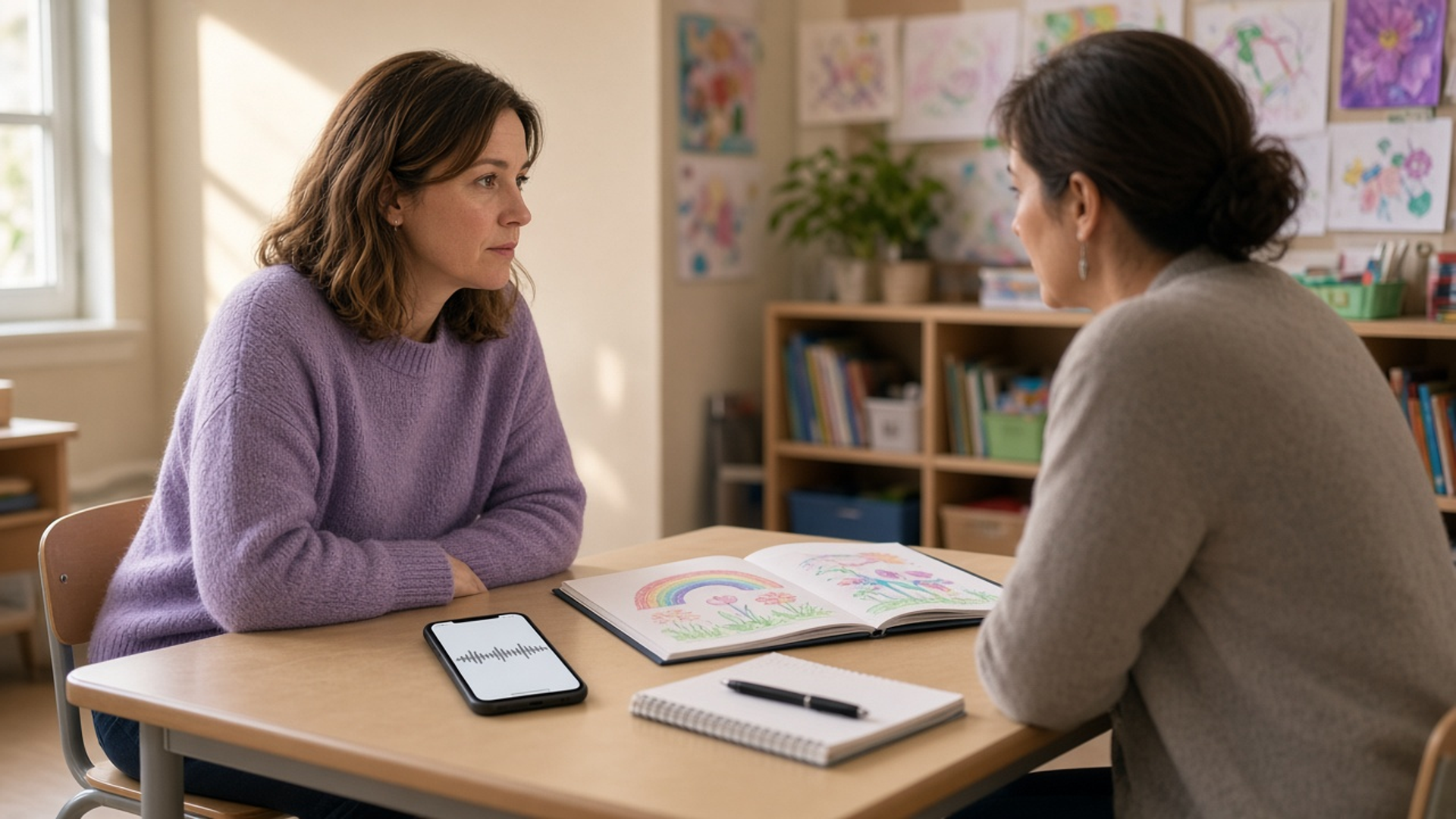
You sit down on a chair built for a nine-year-old. The teacher has a folder open, a clock on the wall, and another family waiting in the hallway. For the next fifteen minutes, someone who spends six hours a day with your child tells you what they see: how she reads, who she sits with, what she avoids, where she has improved, and one or two things the teacher would quietly like you to work on at home.
Then it is over. You walk to the car, and your partner, who could not get off work, texts: "How did it go?"
You type back "Good! She's doing well. Some stuff about reading." And that is roughly all that survives.
A parent-teacher conference is one of the densest conversations of the school year, and almost nobody keeps a record of it.
Why the conference is so hard to remember
It is not that parents do not care. It is that the setting works against memory in almost every way.
It is short and fast. Teachers often have a dozen or more conferences back to back. They have learned to compress a term of observations into a few minutes, which means every sentence carries weight. There is no slow part where you can catch up.
It is emotional. You are hearing someone evaluate your child. Praise lands warmly and blurs the details. Concern lands hard and crowds out everything after it. If the teacher mentions a worry in minute four, you may not hear much of minutes five through fifteen.
It uses a vocabulary you do not speak every day. "She's working toward grade-level fluency." "We're seeing some difficulty with multi-step problems." "He might benefit from a check-in with the learning support team." These phrases mean specific things, and the specifics are exactly what you need later.
The useful parts are offhand. The most practical advice is often tucked into a side comment: "If you read with him, have him explain the story back to you," or "She does much better when she knows the plan for the day." You nod, you mean to remember, and you do not.
What a transcript gives you
If the teacher agrees, recording the conference on your phone and turning it into text changes what you walk away with. Instead of an impression, you have the conversation.
You can hear the worry in context
A transcript lets you reread the part that worried you, calmly, at home. Often it is less alarming on paper than it felt in the room. "She's a little behind where we'd like in math, but she's catching up and I'm not concerned yet" is very different from the version your anxious brain stored, which was "she's behind in math."
Sometimes it goes the other way, and you notice that the teacher raised the same issue three times in slightly different words. That repetition is a signal. It is easy to miss live and obvious in text.
You can share it with the other parent
Conferences rarely work for both parents' schedules. Co-parents in separate households, a parent who travels for work, or a grandparent who does most of the school runs all have a real stake in what was said. Retelling it secondhand loses the teacher's actual words, and the actual words matter.
Sending a transcript, or a few highlighted passages from one, means everyone is working from the same information. Nobody has to trust anybody's summary.
You get the follow-up list for free
Most conferences end with things to do, but they are rarely stated as a list. They are spread across the conversation:
- A book series the teacher suggested.
- A website or app the class uses for practice.
- A request to email the teacher in a few weeks with an update.
- A mention that the school counselor or reading specialist could help.
- Something to watch for at home, like whether homework takes far longer than it should.
Search the transcript for "might," "could," "try," and "let me know," and you will find most of them in a minute or two. Copy them into your notes app, and the conference turns into a plan.
You have a baseline for next time
The spring conference is easier when you can reread the autumn one. What did the teacher say about reading in November? Did the concern about focus come up again? Has the language shifted from "working toward" to "meeting"? Without a record, every conference starts from scratch. With one, you can track progress across a year, or across several teachers.
This is especially useful if your child is being assessed for extra support. Being able to say "In October, Ms. Patel mentioned that he struggles to start written work on his own" is far more effective in a meeting with the school than "I think someone mentioned something about writing."
Ask first, and make it easy to say yes
Recording a conversation with a teacher is something you do with permission, not quietly. Laws on recording vary, and beyond the legal question, it is simply a matter of respect. A teacher who feels secretly recorded will be more guarded, and you will lose the candor that makes the conference useful.
The ask can be simple: "Would you mind if I record this on my phone? My partner couldn't make it and I want to get the details right." Most teachers understand immediately. Framing it around remembering and sharing, not around holding anyone to account, makes a difference.
If the teacher says no, respect it. Take quick notes instead, and write down a few key phrases verbatim the moment you get to the car, before your memory starts tidying them up. Some schools have their own policies, so it is worth checking ahead of time.
A simple routine for the next conference
You do not need a system. A few habits are enough.
- Bring two or three questions. Write them down beforehand. Conferences go faster than you expect, and the teacher's agenda will fill the time if you let it.
- Ask before recording. Put the phone on the table face up, so it is clearly visible.
- Transcribe it the same day. While the conversation is fresh, you can fill in anything the audio missed.
- Highlight three kinds of lines: strengths, concerns, and suggestions. That is usually the whole conference.
- Send the highlights to whoever else needs them. A short message with the teacher's own words beats a paragraph of your paraphrase.
- File it with last term's. A single note or folder per school year is enough to see the arc.
The whole thing takes maybe twenty minutes after the conference. In exchange, you get to actually use what the teacher told you.
The teacher already did the hard part
Teachers prepare for these conversations. They look back over weeks of work, think about what each child needs, and try to say it clearly in very little time. It is one of the few moments when a professional who knows your child well sits down and tells you, directly, what they have noticed.
That deserves a better fate than "some stuff about reading."
If you want an easy way to keep these conversations, To The Text turns recordings from your iPhone into clean, searchable text you can highlight, copy, and share. Record the conference with the teacher's okay, transcribe it on the way home, and keep what was said.